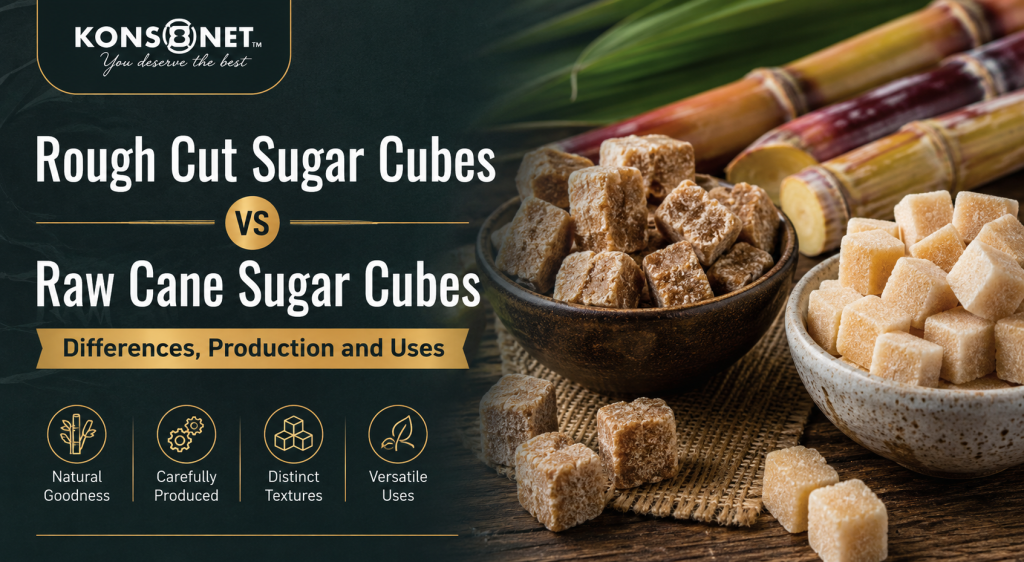
Sugar cubes are a convenient way to sweeten beverages, but not all sugar cubes have the same appearance, texture or production characteristics. Some are made from refined white sugar, while others retain more of the natural colour and flavour associated with less-refined cane sugar. Rough cut sugar cubes and raw cane sugar cubes are two examples that can look similar in their final form but differ in how their sugar crystals are prepared and presented.
The main difference between rough cut sugar cubes and raw cane sugar cubes is their physical structure and manufacturing approach. Rough cut sugar cubes are recognised by their irregular, coarse crystalline appearance, while raw cane sugar cubes generally refer to moulded or compressed cubes made from raw or less-refined cane sugar granules. However, these names are not universally standardised, so actual characteristics depend on the manufacturer’s process and product specification.
For foodservice businesses, wholesalers and hospitality suppliers in Lithuania, understanding these differences can help when selecting sugar products for coffee service, tea presentation, catering and commercial distribution.
This guide explores how both products are made, how they behave in beverages, where they are commonly used and what buyers should consider before sourcing them.
What Are Rough Cut Sugar Cubes?
Rough cut sugar cubes are solid sugar portions recognised by their uneven edges, irregular shapes and coarse crystalline texture. Unlike conventional sugar cubes, which are usually formed into consistent geometric shapes, rough cut varieties have a less uniform appearance.
They are generally produced using cane sugar crystals and a controlled moisture or syrup-binding process that allows the crystals to form a cohesive structure. The final product retains a visibly granular appearance rather than having the smooth, compact finish associated with many conventional sugar cubes.
Their appearance can vary according to the raw material, crystal size and manufacturing method.
For example, Konsonetas describes its Mauritius-origin rough cut sugar cubes as golden brown, with large granular crystals and a characteristic molasses flavour. Its available technical specification also identifies a homogeneous crystal particle size of approximately 0.90 to 1.20 mm.
konsonet.eu
These characteristics make rough cut sugar cubes suitable for businesses looking for a distinctive alternative to standard white sugar portions.
What Are Raw Cane Sugar Cubes?
Raw cane sugar cubes are compact sugar portions produced from raw or less-refined cane sugar granules. The sugar retains some of the colour and flavour characteristics associated with cane-derived materials, although the final result depends on the degree of processing.
Unlike rough cut varieties, raw cane sugar cubes are generally designed around a moulded or compressed structure. Sugar granules are brought together using controlled moisture or a suitable binding process, shaped into cubes and dried until they achieve sufficient strength for handling and packaging.
Their colour can range from light golden to deeper brown. Their texture may also vary from relatively compact to slightly crystalline, depending on the starting sugar and production method.
The term raw cane sugar cube describes a broad product category rather than one fixed manufacturing specification. Consequently, buyers should confirm whether a particular product uses minimally processed cane crystals, partially refined sugar or another cane sugar formulation.
What Is the Difference Between Rough Cut Sugar Cubes and Raw Cane Sugar Cubes?
Although both products can be made using cane-derived sugar, their appearance, structure and production characteristics can differ.
The following comparison highlights their general distinctions.
| Comparison factor | Rough cut sugar cubes | Raw cane sugar cubes |
| Appearance | Irregular and rough-edged | Usually more uniform |
| Texture | Coarse and crystalline | Compact or moderately granular |
| Shape | Less consistent | Generally moulded |
| Raw material | Cane sugar crystals | Raw or less-refined cane sugar |
| Processing | Crystal-based formation and shaping | Moistening, moulding or compression |
| Colour | Often golden or brown | Golden to brown |
| Dissolution | Depends on crystal size and density | Depends on compression and moisture |
| Presentation | Distinctive, rustic appearance | More conventional portioned appearance |
| Applications | Coffee, tea and premium beverage service | Coffee, tea, hospitality and foodservice |
These are general characteristics, not universal rules. Individual manufacturers may use different formulations and production techniques.
1. Appearance and Shape
The most noticeable difference is the physical appearance.
Rough cut sugar cubes have an uneven surface, visible crystals and naturally irregular edges. Their appearance gives them a distinctive presentation compared with conventional sugar cubes.
Raw cane sugar cubes are generally formed into more consistent shapes. Their surfaces may still show individual crystals, but the overall structure tends to look more compact.
For hotels, cafés and restaurants, presentation can influence which format is more suitable for a particular beverage service.
2. Texture and Crystal Structure
Texture depends on the size of the sugar crystals and how tightly they are held together.
Rough cut cubes generally retain a more visibly granular structure. Their coarse appearance is associated with the arrangement of larger sugar crystals.
Raw cane sugar cubes can have a more compact texture because the granules are brought together through moulding or compression.
Neither format automatically indicates higher sugar quality. The important factors are crystal consistency, structural strength, moisture and the product’s intended application.
3. Colour and Flavour
Both products can have golden or brown shades, depending on the cane sugar used.
Colour and flavour are influenced by the presence of residual cane-derived components, including molasses-related compounds, as well as the extent of processing.
Rough cut sugar cubes made from Demerara-style cane sugar can have a characteristic molasses flavour. Raw cane sugar cubes may offer a similar flavour profile, although the intensity depends on the raw material and manufacturing process.
Buyers should assess the actual product specification and, where possible, request samples before choosing a regular supply.
How Are Rough Cut and Raw Cane Sugar Cubes Manufactured?
Understanding the production process helps explain why two products made from cane sugar can have different textures and appearances.
The manufacturing process involves two broad stages: producing the sugar crystals and converting those crystals into a solid portion.
Stage 1: Producing Cane Sugar Crystals
Sugar production begins with extracting juice from harvested sugarcane.
The juice contains sucrose along with water and other naturally occurring substances. It undergoes clarification and evaporation to concentrate the sugar content.
As the syrup becomes concentrated, controlled crystallisation encourages sugar crystals to form. These crystals can then be separated from the remaining liquid through centrifugation and processed further according to the desired sugar grade.
This general process is used in cane sugar manufacturing, although individual factories may follow different production arrangements.
ScienceDirect Topics+1
Stage 2: Forming Rough Cut Sugar Cubes
Rough cut sugar cubes require a production approach that preserves their distinctive crystalline appearance.
The sugar material is prepared with controlled moisture or syrup content so that the crystals can form a cohesive mass. Depending on the production method, the material may be shaped, formed into blocks or processed into individual portions before drying.
The aim is to achieve sufficient structural strength while retaining the coarse, irregular appearance associated with rough cut cubes.
The final texture is influenced by:
- Initial crystal size.
- Moisture level.
- Binding characteristics.
- Formation method.
- Drying conditions.
These variables also influence how the finished cubes behave during storage and handling.
Stage 3: Forming Raw Cane Sugar Cubes
Raw cane sugar cubes are generally produced through a more conventional moulding or compression process.
The manufacturer prepares the cane sugar granules and adjusts their moisture content to achieve the consistency needed for forming.
The material is then placed into moulds or compressed into the required shape. Once formed, the cubes are dried and cooled to develop adequate strength.
Traditional sugar cube manufacturing commonly involves moistening granulated sugar, forming it into cubes and drying the finished portions.
FAOHome+1
The final product can vary according to the granule size, moisture content, pressure applied and drying conditions.
Why Does the Manufacturing Process Matter?
Manufacturing directly affects the finished product’s physical characteristics.
A cube made from larger crystals may have a different surface texture from one formed using finer granules. Similarly, the amount of moisture and the pressure used during production can influence hardness and dissolution.
For commercial buyers, understanding these factors is useful when comparing samples and evaluating whether a product is appropriate for a particular service environment.
How Do the Two Sugar Cube Types Dissolve?
Dissolution is an important consideration for businesses supplying sugar cubes to cafés, restaurants and hospitality venues.
Both rough cut and raw cane sugar cubes dissolve when exposed to water or hot beverages. However, their dissolution behaviour can differ according to several physical properties.
Crystal Size
Smaller crystals generally expose more surface area relative to their volume, allowing water to interact with the sugar more quickly.
Larger crystals may take longer to dissolve, particularly when they are tightly packed within a cube.
Cube Density
Compression influences how easily liquid enters the structure.
A tightly compressed cube may behave differently from a loosely bound crystalline cube, even when both contain similar sugar ingredients.
Temperature and Liquid Movement
Hot beverages generally dissolve sugar more quickly than cold liquids.
Stirring also helps distribute dissolved sugar throughout the drink and reduces the time required for a cube to disappear.
Which Is Better for Coffee and Tea?
There is no universal winner.
Rough cut sugar cubes can suit customers who appreciate a distinctive crystalline appearance and traditional cane sugar character.
Raw cane sugar cubes can be appropriate where uniform portions and consistent presentation are priorities.
The best option depends on beverage temperature, serving style, customer preferences and the product’s actual dissolution performance.
What Are the Common Applications of Rough Cut and Raw Cane Sugar Cubes?
Both products have applications across hospitality, catering and commercial foodservice.
1. Hotels and Hospitality Businesses
Hotels often provide individual sugar portions alongside tea and coffee facilities.
Raw cane sugar cubes can support consistent portion presentation, while rough cut varieties can add a more distinctive appearance to premium beverage arrangements.
The choice depends on the hotel’s service style and the presentation it wants to offer guests.
2. Cafés and Coffee Shops
Coffee shops may offer different sugar options to accommodate customer preferences.
Rough cut cubes can complement traditional coffee service, especially where the visual presentation of ingredients is important.
Raw cane sugar cubes provide another convenient option for customers who prefer individually portioned sweeteners.
3. Restaurants and Fine Dining
Restaurants may use sugar cubes as part of table-side beverage service.
Their appearance, serving convenience and portion consistency can influence the overall presentation.
Rough cut varieties may be suitable for rustic or traditional presentation styles, while more uniform cane sugar cubes can fit standardised table settings.
4. Catering and Event Services
Catering businesses need sugar products that are easy to transport, store and distribute.
Individually portioned sugar cubes can simplify service at conferences, weddings, business events and other gatherings.
For these applications, packaging strength, cube consistency and handling requirements are important purchasing considerations.
5. Wholesale and Food Distribution
Wholesalers supply sugar products to multiple business types, each with different requirements.
Some customers prioritise appearance, while others focus on consistency, packaging and ease of portioning.
Offering different cane sugar cube formats can help distributors serve a wider range of hospitality and foodservice customers.
What Should Wholesale Buyers Consider Before Purchasing?
For wholesalers and commercial buyers in Lithuania, selecting the right sugar cube format requires more than comparing product names.
The following considerations can help businesses make informed purchasing decisions.
1. Product Specifications
Always review the technical specification sheet before placing an order.
Important details include:
- Sugar origin and ingredient composition.
- Crystal size and physical appearance.
- Moisture content.
- Sucrose content.
- Colour and flavour characteristics.
- Microbiological quality.
- Applicable food safety requirements.
These details help buyers compare products objectively and establish whether the sugar meets their intended requirements.
2. Cube Consistency and Handling
For hospitality and foodservice businesses, consistent portions make storage, serving and inventory management easier.
Check whether the cubes maintain their structure during transportation and handling. Rough cut varieties may naturally have more variation in shape, while moulded cubes are generally intended to provide a more uniform format.
3. Packaging and Wholesale Quantities
Packaging should protect sugar cubes from moisture, contamination and physical damage.
Commercial buyers should consider:
- Packaging material and moisture protection.
- Carton weight and dimensions.
- Number of cubes or portions per pack.
- Pallet configuration.
- Minimum order quantities.
- Availability of regular wholesale supply.
These factors are particularly important for distributors supplying multiple hospitality customers.
4. Storage Conditions
Sugar cubes should be stored in clean, cool and dry conditions.
Exposure to moisture can affect their texture, cause clumping and reduce their handling quality. Strong odours and unsuitable storage environments should also be avoided.
Konsonetas’ available technical specification recommends storing its rough cut sugar cubes at approximately 15°C to 25°C, with relative humidity below 70%. It also recommends protection from direct sunlight and external contamination.
For businesses managing larger inventories, suitable warehouse conditions and proper stock rotation can help maintain product quality.
5. Supplier Reliability and Documentation
A dependable wholesale supplier should be able to provide clear product information and relevant documentation.
Before selecting a supplier, buyers should check:
- Product specification sheets.
- Country of origin.
- Food safety documentation.
- Packaging information.
- Batch identification and traceability.
- Delivery arrangements.
- Product availability.
For buyers operating in Lithuania and other European markets, it is also important to confirm that the supplied product meets applicable EU food safety and labelling requirements.
Which Sugar Cube Type Is Better for Commercial Use?
The answer depends on the intended application rather than one product being universally superior.
| Business requirement | Suitable option to consider |
| Distinctive crystalline presentation | Rough cut sugar cubes |
| More uniform portion shapes | Raw cane sugar cubes |
| Traditional coffee and tea service | Both |
| Premium hospitality presentation | Rough cut sugar cubes |
| Standardised table service | Raw cane sugar cubes |
| Wholesale distribution | Depends on customer demand |
| Product differentiation | Rough cut sugar cubes |
For distributors, offering both formats may provide flexibility when serving customers with different presentation and portioning preferences.
For cafés and restaurants, product samples can help establish which format performs better in the beverages they serve.
Ultimately, buyers should evaluate actual specifications, customer preferences and supply consistency before making a purchasing decision.
Conclusion
Rough cut sugar cubes and raw cane sugar cubes both provide convenient ways to sweeten coffee, tea and other beverages, but their physical characteristics and production methods can differ.
Rough cut varieties are distinguished by their irregular shapes, coarse crystalline structure and characteristic appearance. Raw cane sugar cubes are generally formed from raw or less-refined cane sugar granules using moulding or compression techniques.
For hospitality businesses, cafés, restaurants and wholesalers in Lithuania, the right choice depends on presentation, dissolution performance, portion consistency, packaging and customer requirements.
Understanding these differences allows commercial buyers to evaluate sugar products beyond their appearance and select formats that suit their operational needs.
For businesses exploring different cane sugar options, Rough Cut Sugar Cubes provides a starting point for understanding the product and its characteristics.
Frequently Asked Questions (FAQs)
1. Are rough cut sugar cubes and raw cane sugar cubes the same?
No. Both can be made from cane-derived sugar, but they can differ in their manufacturing methods, crystal structure, shape and texture. Rough cut cubes generally have a more irregular crystalline appearance, while raw cane sugar cubes are commonly moulded or compressed into more uniform portions.
2. Are rough cut sugar cubes made from natural cane sugar?
Rough cut sugar cubes can be manufactured using cane sugar crystals. Their final composition depends on the manufacturing process and ingredients used. Buyers should check the technical specification sheet to confirm the product’s ingredients and processing details.
3. Do raw cane sugar cubes contain molasses?
They may retain some molasses-related components depending on the type of cane sugar used and its processing. The amount can vary between manufacturers and products, so the colour alone should not be used to determine molasses content.
4. Which sugar cubes dissolve faster in coffee?
Dissolution depends on crystal size, cube density, moisture and beverage temperature. Smaller crystals and less compact structures may dissolve more readily, while larger crystals or tightly compressed cubes may take longer. Actual performance should be tested under normal serving conditions.
5. Can rough cut sugar cubes be used for tea and coffee?
Yes. They can be used to sweeten tea, coffee and other beverages. Their suitability depends on the desired sweetness, dissolution performance and presentation requirements.
6. Are raw cane sugar cubes suitable for hotels and restaurants?
Yes. Their individually portioned format makes them suitable for hotel breakfast services, restaurant tables, cafés and catering operations. Buyers should select a product with appropriate packaging and consistent specifications.
7. How should rough cut and raw cane sugar cubes be stored?
Both should be kept in clean, cool and dry storage conditions. Packaging should remain protected from moisture, direct sunlight, contamination and strong external odours. Buyers should follow the storage instructions provided by the manufacturer.
8. What should wholesalers check before purchasing sugar cubes?
Wholesalers should evaluate ingredient composition, crystal size, moisture content, appearance, packaging, food safety documentation, origin and supply consistency. Requesting product samples and technical specifications can help with supplier comparisons.
9. Can rough cut sugar cubes be purchased in bulk?
Yes. Rough cut sugar cubes can be supplied for commercial and wholesale applications, depending on manufacturer availability, packaging formats and order requirements. Buyers should confirm minimum order quantities, carton sizes and delivery arrangements directly with their supplier.
Contact Konsonetas
Businesses looking for cane sugar products for wholesale distribution, hospitality or foodservice applications can contact Konsonetas to discuss product specifications, packaging and supply requirements.
For additional business information, visit the Konsonetas Google Business Profile.