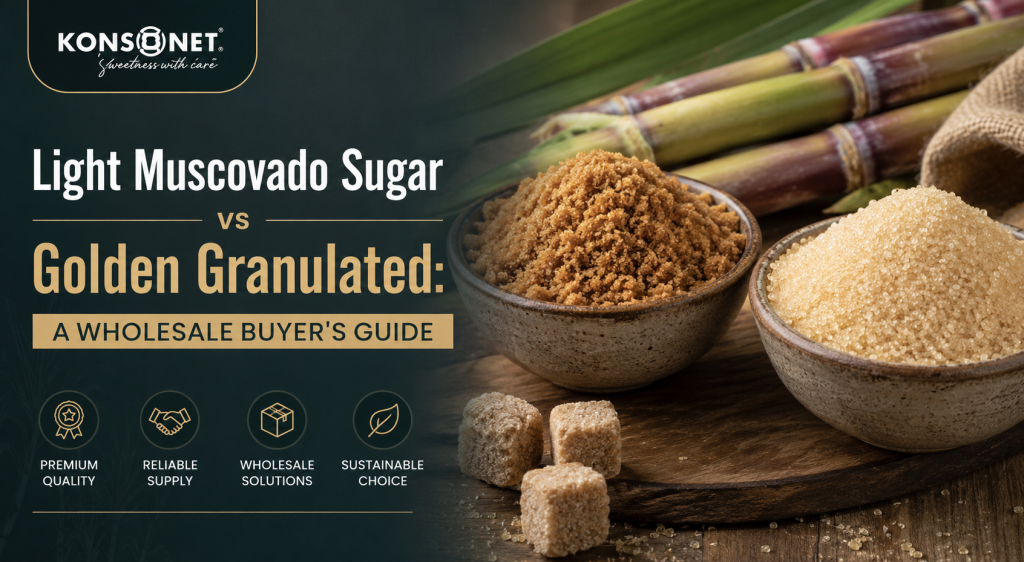
Choosing the right sugar for food manufacturing involves more than comparing sweetness or price. Moisture content, crystal size, colour, flavour and handling characteristics can all influence the final product and production efficiency. Two options that serve different purposes are light muscovado sugar and golden granulated sugar.
Light muscovado sugar is a soft, moist cane sugar containing natural molasses, giving it a light brown colour, a sticky texture and a distinctive caramel-like flavour. Golden granulated sugar, in contrast, is a dry, free-flowing sugar with golden crystals, a subtle buttery taste and low moisture content. While light muscovado is particularly suitable for products requiring moisture and a richer flavour, golden granulated is useful where consistent sweetness, easy handling and free-flowing crystals are important.
For wholesalers, food manufacturers, bakeries and ingredient distributors in Lithuania, understanding these differences helps determine which sugar is appropriate for specific production requirements.
1. What Is Light Muscovado Sugar?
Light muscovado sugar is an unrefined or minimally processed cane sugar that retains natural molasses, contributing to its characteristic colour, moisture and flavour.
Unlike dry granulated sugars, light muscovado has a soft, slightly sticky texture. Its fine, light brown crystals are associated with a distinctive aroma and a mild caramel-like taste.
The natural molasses content makes it particularly useful in food applications where manufacturers want to introduce additional flavour, moisture and colour.
What Are Its Main Characteristics?
Light muscovado typically offers:
- Colour: Light brown crystals with a natural molasses appearance.
- Texture: Soft, moist and slightly sticky.
- Flavour: Mild caramel-like notes with a distinctive molasses character.
- Moisture: Higher moisture content than dry granulated sugar.
- Applications: Confectionery, baking, sauces and selected sweet and savoury products.
According to Konsonet’s published technical specifications, its Light Muscovado has a polarisation range of 93–97 °Z, a colour value of 7,000–10,000 I.U., maximum moisture of 1.50% and grain size of 0.30–0.40 mm.
These characteristics help manufacturers assess whether the ingredient is appropriate for their formulations.
Businesses looking for technical product information can explore Light Muscovado sugar specifications and product details.
2. What Is Golden Granulated Sugar?
Golden granulated sugar is a dry, free-flowing cane sugar characterised by its sparkling golden colour and subtle buttery taste.
Its relatively low moisture content and granular structure make it suitable for applications where manufacturers need a sugar that can be measured, handled and incorporated into different food products.
Compared with light muscovado, golden granulated has a more neutral flavour profile. It provides sweetness without introducing the same level of molasses character.
Just Read : What Is Golden Granulated Sugar and How Is It Used in Baking
What Are Its Main Characteristics?
Golden granulated generally offers:
- Colour: Light golden crystals.
- Texture: Dry, granular and free-flowing.
- Flavour: Subtle buttery notes with a relatively mild flavour.
- Moisture: Low moisture content.
- Applications: Beverages, cereals, jams, marmalades, cakes and biscuits.
Konsonet’s published specifications for Golden Granulated indicate a minimum polarisation of 90.40 °Z, colour of 400–800 I.U., maximum moisture of 0.10% and grain size of 0.60–0.85 mm.
These measurements provide useful reference points when evaluating ingredient suitability.
For businesses interested in the product’s retail presentation, see Golden Granulated sugar from Mauritius.
3. What Is the Difference Between Light Muscovado and Golden Granulated Sugar?
The main difference is their moisture content, molasses characteristics, texture and intended food applications.
Light muscovado is designed for formulations where a soft texture, additional moisture and a richer cane sugar flavour are desirable. Golden granulated is more appropriate when manufacturers require a dry, free-flowing ingredient with a subtler flavour.
The following comparison highlights the differences relevant to wholesale purchasing.
| Comparison factor | Light Muscovado | Golden Granulated |
| Appearance | Light brown | Golden |
| Texture | Soft and moist | Dry and free-flowing |
| Molasses character | More pronounced | Subtle |
| Flavour | Caramel-like | Mild buttery |
| Moisture | Max. 1.50% | Max. 0.10% |
| Grain size | 0.30–0.40 mm | 0.60–0.85 mm |
| Main applications | Confectionery, baking and sauces | Beverages, cereals, jams and baking |
| Handling | May require attention to clumping | Easier free-flowing handling |
The figures above refer to Konsonet’s published product specifications, rather than universal specifications for every supplier.
How Do Their Colours and Flavours Affect Food Products?
Light muscovado contributes a more noticeable brown colour and molasses character. This can be useful when manufacturers want these characteristics to become part of the finished product.
Golden granulated offers a lighter appearance and subtler taste. It is generally more suitable when the original flavour of other ingredients needs to remain prominent.
For example, a bakery producing gingerbread may prefer light muscovado for its characteristic flavour. A manufacturer producing a sweetened cereal blend may prefer golden granulated because of its dry structure and milder flavour.
How Does Moisture Content Influence Their Performance?
Moisture content is an important consideration in food manufacturing.
Light muscovado contains more moisture, which can contribute to softness in certain baked goods and confectionery products. However, manufacturers must account for this additional moisture when developing recipes and maintaining consistent production results.
Golden granulated has a much lower moisture content. Its dry structure makes it easier to handle in automated weighing, dosing and packaging operations.
The choice should therefore reflect the moisture requirements of the finished product and the capabilities of the manufacturing equipment.
4. Which Sugar Is Better for Different Food Manufacturing Applications?
Neither product is universally better. Their suitability depends on the formulation, desired flavour and production process.
Light Muscovado for Baking and Confectionery
Light muscovado is particularly suitable for recipes that benefit from a richer cane sugar flavour and additional moisture.
Common applications include:
- Gingerbread and spiced cakes.
- Fruitcakes and selected bakery products.
- Caramel-flavoured confectionery.
- Sweet and sour sauces.
- Selected savoury marinades and glazes.
- Popcorn coatings.
Its soft texture and natural molasses character can contribute to the desired sensory properties of these products.
For commercial bakeries, testing the ingredient in the actual recipe is important because its moisture and flavour can influence the finished product.
Golden Granulated for Beverages and Packaged Foods
Golden granulated is suitable for products requiring dry, free-flowing sugar with a relatively mild flavour.
Common applications include:
- Tea and coffee sweetening products.
- Breakfast cereals.
- Jam and marmalade manufacturing.
- Cakes and biscuits.
- Fruit preparations.
- Wine-making applications where the formulation permits.
Its low moisture content also makes it suitable for applications such as individual sugar-stick packaging.
For manufacturers producing large quantities of packaged food, its handling characteristics can be particularly useful.
5. How Does Sugar Processing Affect Product Characteristics?
The differences between these sugars are closely related to their processing and the characteristics retained in the finished crystals.
Muscovado production generally involves retaining a greater proportion of natural molasses during processing. This contributes to its moist structure, brown colour and distinctive flavour.
Golden granulated is processed into dry, free-flowing crystals. Its finished characteristics include lower moisture, a lighter golden colour and a more subtle flavour.
The precise manufacturing process can vary between producers, so wholesale buyers should request technical documentation rather than assume all products labelled with the same sugar name have identical specifications.
For manufacturers, the important consideration is how the finished ingredient behaves in their production process.
6. What Should Wholesale Buyers Consider Before Purchasing?
Selecting a wholesale sugar supplier requires evaluating more than the price per kilogram.
Businesses should consider product consistency, specifications, packaging, storage requirements and the supplier’s ability to support regular purchasing needs.
1. Technical Specifications
Request a current technical specification sheet before placing a bulk order.
Important parameters include:
- Moisture content.
- Polarisation.
- Colour value.
- Grain size.
- Appearance and texture.
- Product origin.
- Relevant food safety documentation.
These details help manufacturers compare products using measurable criteria.
2. Packaging and Order Requirements
Packaging should match the purchasing volume and the buyer’s storage and production arrangements.
For example, manufacturers purchasing sugar regularly may prefer bulk bags that can be transferred efficiently into ingredient storage systems.
Konsonet provides wholesale sugar options through its bulk food product catalogue.
Buyers should confirm current packaging formats, minimum order quantities and delivery arrangements directly with the supplier.
3. Batch Consistency
Consistency is particularly important for businesses producing the same food products throughout the year.
Differences in colour, moisture or grain size can affect recipe performance, processing conditions and the appearance of finished goods.
Requesting technical documentation and checking incoming batches against agreed specifications can help reduce unexpected variations.
4. Supplier Reliability and Traceability
A dependable supplier should be able to provide clear product information, origin details and relevant quality documentation.
Wholesale buyers should also consider communication, order planning, delivery terms and the supplier’s ability to accommodate repeat requirements.
For businesses operating in Lithuania and other European markets, checking the documentation required for their particular supply chain is also important.
7. How Should Light Muscovado and Golden Granulated Sugar Be Stored?
Correct storage helps preserve sugar quality and reduces problems associated with moisture absorption and contamination.
Although both products are shelf-stable under appropriate conditions, their different physical characteristics require attention.
Storing Light Muscovado
Because light muscovado contains more moisture, it should be protected from excessive exposure to air and unsuitable storage conditions.
Recommended practices include:
- Keep the sugar in sealed, food-grade packaging.
- Store it in a cool, dry and clean environment.
- Protect it from external moisture and contamination.
- Avoid unnecessary exposure to air during production.
- Follow the supplier’s recommended storage conditions.
Its moist structure can lead to clumping, particularly when exposed to unsuitable humidity conditions.
Storing Golden Granulated
Golden granulated is easier to handle because of its dry, free-flowing structure.
However, it should still be stored appropriately.
Businesses should:
- Keep packaging sealed when not in use.
- Store bags away from direct moisture.
- Maintain clean and dry storage areas.
- Protect the product from pests and contamination.
- Follow the supplier’s handling and storage guidance.
Good warehouse practices help maintain the product’s physical quality throughout storage and distribution.
8. How Can Businesses Select the Right Sugar for Their Requirements?
The most effective way to choose between light muscovado and golden granulated is to start with the intended application.
Businesses should consider the following questions:
Does the recipe require a noticeable molasses flavour?
Light muscovado is generally more suitable when a caramel-like flavour and richer cane sugar character are required.
Does the production process require dry, free-flowing crystals?
Golden granulated is generally more appropriate for applications involving automated weighing, dry blending and portion packaging.
Is additional moisture desirable in the finished product?
Light muscovado may be preferable for formulations where its moisture characteristics contribute to the desired texture.
Does the finished product require a relatively neutral sugar flavour?
Golden granulated is a more suitable option when the sugar should contribute sweetness without a pronounced molasses flavour.
Can the supplier maintain the required specifications?
Both products should be assessed against technical requirements, batch documentation and purchasing arrangements.
For larger manufacturers, conducting production trials before committing to substantial wholesale orders is a practical way to evaluate ingredient performance.
Conclusion
Light muscovado sugar and golden granulated sugar serve different purposes in commercial food production. Light muscovado is a suitable choice for manufacturers looking for a moist sugar with natural molasses characteristics, a richer flavour and applications in baking and confectionery.
Golden granulated is more appropriate for businesses requiring dry, free-flowing sugar with a subtle taste and versatility across beverages, cereals, jams and other packaged foods.
For wholesale buyers in Lithuania, the right purchasing decision should consider technical specifications, formulation requirements, handling characteristics, packaging and supplier consistency.
Working with an experienced ingredient supplier can help businesses identify suitable products and plan their sourcing requirements more effectively.
Businesses interested in sourcing cane sugar and other food ingredients can contact Konsonetas to discuss their wholesale requirements and product specifications.
Frequently Asked Questions
1. Is light muscovado sugar the same as golden granulated sugar?
No. Light muscovado is a soft, moist sugar containing natural molasses, while golden granulated is a dry, free-flowing sugar with a subtler flavour. Their moisture content, texture, colour and applications are different.
2. Which sugar has more moisture, light muscovado or golden granulated?
Light muscovado has a higher moisture content. Konsonet specifies a maximum of 1.50% for its Light Muscovado, compared with a maximum of 0.10% for its Golden Granulated.
3. Can golden granulated sugar replace light muscovado in commercial baking?
It can replace some of the sweetness, but it may not reproduce the same flavour, colour or moisture contribution. Manufacturers should test recipe adjustments before making a substitution in commercial production.
4. Is light muscovado suitable for industrial food manufacturing?
Yes. It can be used in commercial baking, confectionery, sauces and other food applications where its flavour and moisture characteristics are desirable. Suitability depends on the manufacturer’s formulation and processing requirements.
5. Why is golden granulated sugar suitable for bulk food production?
Its dry, free-flowing structure and low moisture content can support handling, weighing, blending and packaging operations. Its relatively mild flavour also makes it suitable for different food formulations.
6. What specifications should wholesale buyers check when purchasing sugar?
Buyers should review moisture content, polarisation, colour, grain size, product origin, packaging and relevant food safety documentation. These specifications help determine whether the ingredient meets production requirements.
7. How should wholesale light muscovado sugar be stored?
It should be kept in sealed, food-grade packaging in a clean, cool and dry storage environment. Protecting it from excessive moisture and air exposure helps reduce clumping and maintain product quality.
8. Can manufacturers purchase light muscovado and golden granulated sugar in bulk?
Yes. Both types are available in wholesale supply channels. Buyers should contact the supplier to confirm current availability, packaging formats, minimum order quantities and delivery arrangements.
9. Which sugar should a food manufacturer choose?
The decision depends on the finished product. Light muscovado is suitable when additional moisture and molasses flavour are required, while golden granulated is preferable when dry, free-flowing crystals and a subtler flavour are important.