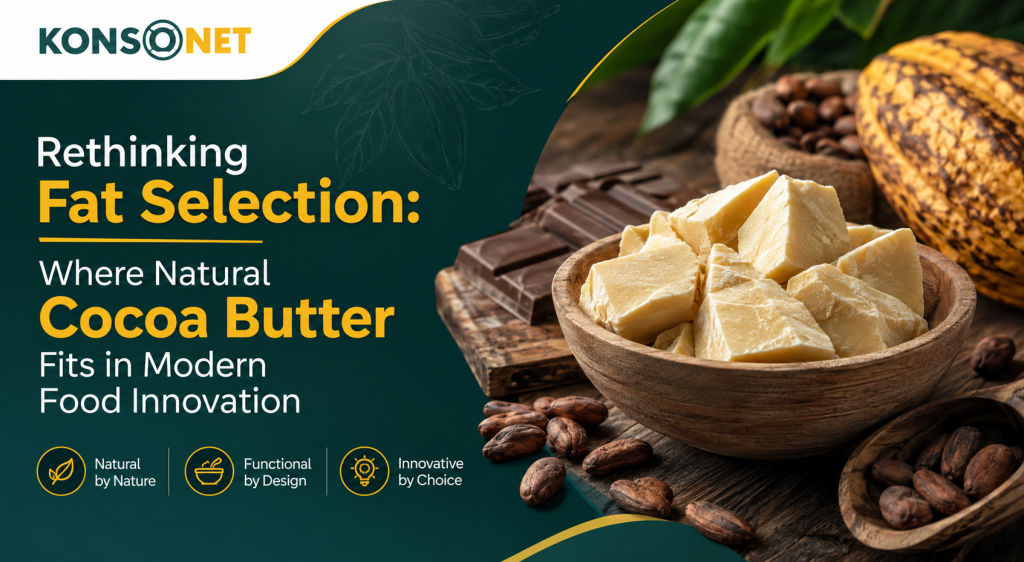
Choosing the right fat is no longer simply a matter of cost, melting point, or availability. Food manufacturers today have to consider texture, flavor, processing behavior, ingredient expectations, product stability, and application-specific performance at the same time. That is where natural cocoa butter continues to earn attention.
Natural cocoa butter is a plant-derived fat obtained from cocoa beans. It is particularly important in chocolate and confectionery, but its role can extend into bakery products, fillings, coatings, spreads, cosmetics-inspired food concepts, and other applications where a distinctive fat profile is useful.
For manufacturers, the important question is not whether cocoa butter is universally better than other fats. It is whether its characteristics match the technical and sensory requirements of a particular product.
For businesses such as Konsonetas, operating in the global ingredient landscape, understanding this distinction is essential when evaluating cocoa-derived ingredients for different food applications.
Key Takeaway
Natural cocoa butter is valuable because it combines a recognizable cocoa origin with specific melting, texture, flavor, and processing characteristics. Rather than treating it as a simple replacement for another fat, food developers should evaluate it according to the finished product, processing conditions, desired sensory experience, and ingredient specifications.
That approach makes fat selection more practical and can help manufacturers create products that perform consistently while meeting changing consumer expectations.
Why Fat Selection Has Become More Complicated
Fats have always played several roles in food production. They can contribute to mouthfeel, structure, lubrication, flavor release, melting behavior, moisture management, and product stability.
But modern food development has added more considerations.
Consumers increasingly look at ingredient lists and may pay attention to the source and perceived simplicity of ingredients. At the same time, manufacturers must maintain production efficiency and consistent product quality.
This creates a balancing act.
A fat may perform well technically but deliver the wrong mouthfeel. Another may have a desirable nutritional or sourcing profile but behave poorly during processing. A third may offer the right texture but introduce unwanted flavor characteristics.
Cocoa butter is interesting because its functionality is closely connected to its natural composition and cocoa origin.
Instead of asking, “Which fat is cheapest?” a better product-development question is:
“Which fat gives this product the physical and sensory characteristics we actually need?”
That shift can lead to better ingredient decisions.
What Makes Natural Cocoa Butter Different?
Cocoa butter is the fat naturally present in cocoa beans. It is separated during cocoa processing and is widely associated with chocolate manufacturing.
One of its defining characteristics is its behavior around body temperature. Properly processed cocoa butter can provide a firm structure at room temperature while melting relatively quickly in the mouth.
That melting behavior is one reason it is so important in chocolate.
But melting point alone does not explain its value.
Natural cocoa butter also contributes to the characteristic sensory profile associated with cocoa-based products. Depending on how it is processed and specified, it can retain varying degrees of cocoa aroma and flavor.
For food manufacturers, this means cocoa butter can influence both how a product behaves and how it feels when consumed.
These two properties often need to be considered together.
Natural Cocoa Butter vs. Other Vegetable Fats
Modern food manufacturers have access to many vegetable fats, including coconut-derived fats, palm-based fats, shea-derived fats and various specialty fat systems.
There is no single fat that is ideal for every application.
The right choice depends on the intended result.
| Consideration | Natural Cocoa Butter | Other Vegetable Fats |
| Cocoa association | Strong | Usually limited or absent |
| Chocolate applications | Highly relevant | Often used for specific formulation purposes |
| Mouthfeel | Distinctive, clean melting behavior | Varies by fat |
| Flavor contribution | Can contribute cocoa characteristics | Depends on source and processing |
| Texture | Useful for structure and snap | Application dependent |
| Formulation flexibility | Depends on application | Can vary significantly |
| Ingredient positioning | Cocoa-derived, plant-based | Depends on source |
The purpose of this comparison is not to identify a universal winner. Instead, it highlights why formulation decisions should be application-led.
A manufacturer developing a chocolate coating may prioritize different characteristics from a company producing a bakery filling or a functional food.
Where Natural Cocoa Butter Fits in Chocolate Innovation
Chocolate remains the most obvious application for cocoa butter, but even within chocolate production, formulation requirements can vary considerably.
Cocoa butter contributes to several characteristics that consumers associate with high-quality chocolate products.
1. Melting Behavior
One of cocoa butter’s most recognized characteristics is its melting behavior.
A well-formulated chocolate product can remain relatively firm under suitable storage conditions and then melt smoothly when consumed.
This transition is central to the eating experience.
2. Texture and Snap
Cocoa butter plays an important role in chocolate structure.
When chocolate is properly formulated and tempered, the fat contributes to the characteristic firmness and snap that consumers often expect from solid chocolate.
This makes fat selection closely connected to processing technique.
3. Mouthfeel
A chocolate product should not simply melt; it should melt in a way that feels appropriate for the product.
Cocoa butter can provide a smooth, relatively clean mouthfeel when used correctly.
That characteristic can be particularly important in premium chocolate, filled chocolates, bars and coatings.
4. Flavor Experience
Chocolate is fundamentally a sensory product.
Even when cocoa butter is not the primary source of cocoa flavor, its presence forms part of the traditional fat system used in chocolate production.
For developers, this means ingredient selection can influence the overall sensory balance of the finished product.
Could Natural Cocoa Butter Support Cleaner Ingredient Strategies?
The phrase “clean label” can mean different things to different consumers and manufacturers. There is no universal definition that automatically makes an ingredient better.
However, ingredient transparency has become an important consideration in food development.
A manufacturer may want to use recognizable ingredients, reduce unnecessary complexity, or communicate a clearer ingredient story.
In that context, a cocoa-derived fat can be attractive when it fits the formulation.
But it is important to avoid assuming that every product containing natural cocoa butter automatically qualifies for a particular marketing claim.
Claims such as “organic,” “natural,” or “non-GMO” depend on the actual ingredient specification, sourcing and applicable regulations.
This is where careful supplier documentation becomes important.
Understanding Pure Natural Cocoa Butter
Pure Natural Cocoa Butter generally refers to cocoa butter that is supplied without unnecessary blending with other fats or ingredients, subject to the exact product specification.
For manufacturers, the word “pure” should not simply be treated as a marketing term.
The practical questions are more important:
- What is the ingredient specification?
- What processing has it undergone?
- What are its physical characteristics?
- What is its intended application?
- What quality parameters are controlled?
- How consistent is the material between batches?
- What documentation is available?
A product specification sheet can provide much more useful information than a label claim alone.
For formulation teams, purity should always be evaluated in relation to the requirements of the finished product.
Is Organic Cocoa Butter Better?
Organic Cocoa Butter can be relevant when a finished food product is being developed around certified organic ingredients.
However, organic status is not something that should be assumed simply because cocoa butter is naturally derived.
Organic claims depend on the production and certification framework applicable to the ingredient and the market where it will be sold.
Therefore, manufacturers considering organic cocoa butter should verify the appropriate certification and documentation before using an organic claim on packaging.
This is especially important for international food businesses because requirements can differ between markets.
The practical lesson is simple:
Do not select an ingredient based only on the word “organic.” Verify the certification and make sure it matches the intended market and product claim.
What About Unrefined Cocoa Butter?
Unrefined Cocoa Butter is another option that can attract attention, particularly when manufacturers want an ingredient with a less processed positioning.
The term generally suggests that the ingredient has undergone less intensive refining than highly processed alternatives. As a result, its color, aroma, flavor and other characteristics may differ.
That can be an advantage in some applications and a limitation in others.
For example, a manufacturer developing a product where subtle cocoa characteristics are desirable may appreciate these qualities.
On the other hand, a formulation requiring a very neutral fat may need a more refined specification.
This is why “unrefined” should not automatically be interpreted as “better.”
The correct question is:
Does the ingredient’s natural character support the sensory and technical requirements of the final product?
Beyond Chocolate: Other Potential Applications
Although chocolate is the classic application, food innovation continues to explore different ways of using cocoa-derived fats.
Bakery Products
Fat plays an important role in bakery formulation.
It can influence tenderness, mouthfeel, structure and richness.
Cocoa butter may be considered in selected bakery applications where its physical properties and flavor profile fit the recipe.
However, it should not be substituted directly into every bakery formulation without testing.
Different fats behave differently during mixing, baking and cooling.
Fillings and Creams
Fillings require careful control of fat behavior because texture can change dramatically with temperature.
Cocoa butter may be useful where a firm-at-room-temperature structure combined with a smooth melt is desirable.
The exact ratio, processing conditions and other ingredients will determine the final result.
Coatings
Cocoa butter is particularly relevant to coatings because melting and solidification characteristics are central to coating performance.
Developers may need to evaluate:
- Setting time
- Surface appearance
- Texture
- Mouthfeel
- Temperature sensitivity
- Compatibility with the product underneath
The correct cocoa butter specification can therefore become part of the broader coating strategy.
Confectionery
Beyond conventional chocolate bars, cocoa butter can be relevant to pralines, truffles, molded products, compound-style formulations and other confectionery concepts.
Each application presents a different balance of texture, melting behavior and processing requirements.
Specialty Food Products
Food innovation increasingly involves products that do not fit traditional categories.
Cocoa-derived fats may be evaluated for specialty formulations where the developer wants a particular physical property or ingredient story.
The key is still application testing rather than assuming that one ingredient will perform identically across every category.
What Should Product Developers Check Before Buying?
Buying cocoa butter based solely on price can create problems later.
A better sourcing process starts with the finished product.
1. Define the Application
First identify exactly where the ingredient will be used.
Chocolate, coating, filling, bakery and other applications can require different characteristics.
2. Review the Specification
Check relevant technical information such as:
- Appearance
- Color
- Aroma
- Flavor
- Melting characteristics
- Moisture
- Impurity limits
- Packaging
- Storage conditions
- Shelf-life information
The specific parameters needed will depend on the application and supplier specification.
3. Consider Processing Requirements
Ask how the cocoa butter behaves under the actual manufacturing conditions.
Will it be melted, mixed, cooled, tempered or combined with other fats?
Laboratory testing should reflect the real process as closely as practical.
4. Evaluate Sensory Impact
Do not rely exclusively on laboratory numbers.
Taste, aroma, mouthfeel and appearance can all affect consumer acceptance.
A small difference in cocoa aroma may be irrelevant in one application but important in another.
5. Confirm Documentation
For commercial production, documentation matters.
Depending on the market and application, buyers may need information relating to specifications, traceability, food safety, origin or certifications.
The exact documentation required should be established before procurement.
Common Mistakes When Selecting Cocoa Butter
Even a technically suitable ingredient can create problems if it is selected without considering the full formulation.
Mistake 1: Treating All Cocoa Butter as Identical
Different processing methods and specifications can affect characteristics.
A sample that performs well does not mean every future material with the same general ingredient name will behave identically.
Better approach: Define measurable specifications and approve suppliers against them.
Mistake 2: Choosing on Price Alone
A lower ingredient price does not necessarily mean a lower total formulation cost.
If the ingredient creates processing difficulties, inconsistent texture or additional adjustments, the apparent saving may disappear.
Better approach: Consider performance, consistency and application fit alongside price.
Mistake 3: Ignoring Temperature
Fat behavior is temperature-dependent.
Storage, transportation, manufacturing and final use conditions can all influence performance.
Better approach: Test the ingredient under realistic temperature conditions.
Mistake 4: Assuming “Natural” Means Suitable for Every Product
Natural origin does not automatically make an ingredient technically appropriate.
Every formulation has its own requirements.
Better approach: Evaluate the ingredient according to functionality first, then consider positioning and claims.
Mistake 5: Using Organic Claims Without Verification
Organic status needs appropriate certification and documentation.
Better approach: Verify the certification applicable to the ingredient and target market before making claims.
How Manufacturers Can Make Better Fat Decisions
A practical fat-selection framework can make product development more efficient.
Start with five questions:
What texture do we want?
Should the finished product be firm, creamy, soft, crisp or quick-melting?
What temperature range will it experience?
Consider manufacturing, storage, transportation and consumption.
Should the fat contribute flavor?
Some products benefit from cocoa characteristics, while others require a more neutral profile.
How will the fat interact with other ingredients?
Chocolate, sugar, milk components, nuts, emulsifiers and other fats can all influence the final structure.
What ingredient story does the product need?
If the product is positioned around organic or minimally processed ingredients, verify that the chosen raw material genuinely supports those claims.
These questions turn fat selection from a generic purchasing decision into a formulation decision.
The Role of Supplier Communication
Ingredient sourcing works better when product developers communicate the intended application clearly.
Instead of simply asking for a quotation for cocoa butter, buyers can explain:
- What product they are developing
- Expected processing conditions
- Desired texture
- Required flavor profile
- Target market
- Packaging requirements
- Certification expectations
- Approximate volume requirements
This allows suppliers to understand the actual need rather than responding only to an ingredient name.
For global ingredient sourcing, this type of communication can be particularly useful because specifications, documentation and market requirements may vary.
Konsonetas can be considered as part of that sourcing conversation for businesses evaluating cocoa-derived ingredients and looking for information aligned with their food manufacturing requirements.
Natural Cocoa Butter and the Future of Food Innovation
Food innovation is moving in several directions simultaneously.
Consumers want enjoyable products, but they also increasingly pay attention to ingredients. Manufacturers want efficient production, but they also need flexibility. Product developers need distinctive sensory experiences while maintaining consistent quality.
This makes ingredient selection more strategic.
Natural cocoa butter is unlikely to be the right answer for every formulation. It does, however, have a specific combination of characteristics that makes it valuable in applications where melting behavior, structure, mouthfeel and cocoa origin matter.
The future of fat selection is therefore less about identifying one “best” ingredient and more about matching the right ingredient to the right purpose.
That principle applies to both established products and emerging food concepts.
A Practical Checklist for Buyers
Before committing to a cocoa butter ingredient, use this checklist:
Application
- What product will contain the cocoa butter?
- What role will the fat play?
Performance
- What melting and texture characteristics are required?
- How will the ingredient behave during processing?
Sensory
- Is cocoa aroma desirable?
- Does the ingredient deliver the required mouthfeel?
Specification
- Are technical parameters clearly documented?
- Is batch-to-batch consistency adequately controlled?
Claims
- Is organic certification required?
- Are other ingredient claims relevant?
Supply
- Is the packaging suitable?
- Are storage and transport conditions understood?
- Can the supplier support the expected volume?
Testing
- Has the ingredient been tested in the actual formulation?
- Has the finished product been evaluated after storage?
This checklist can prevent many avoidable sourcing and formulation issues.
FAQs About Natural Cocoa Butter
1. What is natural cocoa butter?
Natural cocoa butter is the fat naturally present in cocoa beans. It is obtained during cocoa processing and is widely used in chocolate and confectionery because of its distinctive melting, texture and sensory characteristics.
2. Is natural cocoa butter only used for chocolate?
No. Chocolate is its most established food application, but cocoa butter can also be considered for selected bakery products, fillings, coatings and confectionery formulations where its physical and sensory properties are appropriate.
3. What is the difference between pure natural cocoa butter and regular cocoa butter?
The exact distinction depends on the supplier’s specification and terminology. “Pure” generally indicates that the product is cocoa butter rather than a blend with other fats. Buyers should review the technical specification rather than relying on terminology alone.
4. Is Organic Cocoa Butter automatically better?
Not necessarily. Organic cocoa butter may be important when a manufacturer needs certified organic ingredients, but technical suitability still matters. The certification and documentation should also be verified for the intended market.
5. What does unrefined cocoa butter mean?
Unrefined cocoa butter generally refers to cocoa butter that has undergone less intensive refining. It may retain more of its natural color, aroma or flavor than more highly processed forms, depending on the specific production method.
6. Can cocoa butter replace other vegetable fats?
Sometimes, but substitution should not be treated as a simple one-for-one change. Different fats have different melting, crystallization, flavor and processing characteristics. Reformulation and testing are normally necessary.
7. Why is cocoa butter important for chocolate texture?
Cocoa butter contributes to chocolate’s structure and melting characteristics. When chocolate is properly formulated and processed, it helps create the firmness, snap and smooth melt associated with many chocolate products.
8. What should manufacturers check when sourcing cocoa butter?
Manufacturers should consider the intended application, technical specification, sensory characteristics, processing behavior, documentation, packaging, storage requirements, certifications where relevant, and supplier consistency.
9. How should food manufacturers test cocoa butter before full production?
The ingredient should ideally be tested in the intended formulation and under realistic processing and storage conditions. Both technical performance and sensory characteristics should be evaluated before large-scale adoption.
Final Thoughts
Fat selection is becoming a more deliberate part of food innovation. Manufacturers are no longer looking only at whether an ingredient performs a basic technical function; they are considering its effect on texture, flavor, processing, ingredient positioning and the overall consumer experience.
That is where natural cocoa butter has a distinctive role.
It offers a cocoa-derived fat with characteristics that can be particularly valuable in chocolate, confectionery, coatings, fillings and selected specialty applications. Pure Natural Cocoa Butter, Organic Cocoa Butter and Unrefined Cocoa Butter can each serve different formulation goals, but the right choice depends on verified specifications and the requirements of the finished product.
The most effective approach is not to select a fat because it is fashionable or because one attribute sounds appealing. Start with the product, define the required performance, evaluate the ingredient carefully, and test it under realistic conditions.
For manufacturers exploring cocoa-based ingredients and global sourcing options, Konsonetas can be a useful point of contact for discussing ingredient requirements and evaluating suitable cocoa-derived solutions.
The right fat is not simply the one that fits the ingredient list—it is the one that helps the finished product perform exactly as intended.