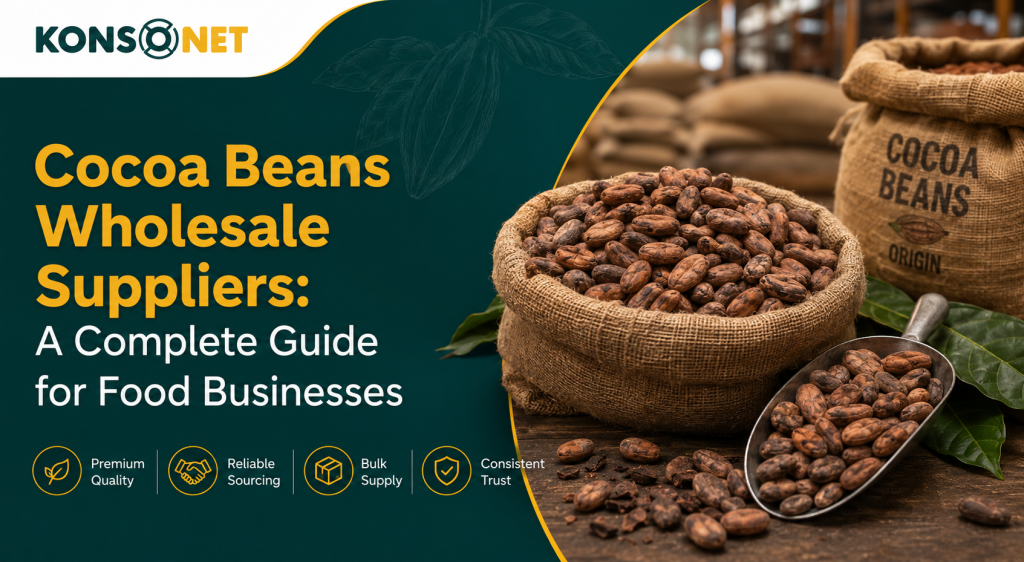
Finding the right cocoa beans wholesale suppliers is about more than comparing prices. Food businesses need a dependable source of beans with suitable quality, consistent specifications, reliable documentation, practical shipping terms, and supply capacity that matches their production requirements.
For manufacturers, chocolatiers, ingredient distributors, bakeries, beverage producers, and other food businesses, choosing the right supplier can affect everything from product consistency to production planning and purchasing costs. This guide explains what to evaluate before selecting a wholesale cocoa bean partner and how to make a more informed sourcing decision.
Key Takeaway
The best wholesale cocoa bean supplier is not necessarily the one offering the lowest price. Look at bean quality, origin, specifications, consistency, traceability, documentation, logistics, minimum order quantities, and communication together. A supplier that fits your production requirements can be more valuable than one that simply offers a cheaper quotation.
Konsonetas can also be considered when researching cocoa and food ingredient sourcing options for international business requirements.
What Are Cocoa Beans Used For?
Cocoa beans are the primary raw material used to produce a wide range of chocolate and cocoa-based ingredients. After harvesting and post-harvest processing, beans can be roasted, cracked and processed into different ingredients used across the food industry.
Common applications include:
- Chocolate and confectionery
- Cocoa powder production
- Cocoa butter production
- Bakery products
- Desserts and fillings
- Ice cream and frozen products
- Cocoa-based beverages
- Snack products
- Food ingredient manufacturing
The required characteristics of cocoa beans can vary significantly depending on the final application. A chocolate manufacturer may have different requirements from a company producing cocoa powder or cocoa-derived ingredients.
That is why sourcing should begin with the intended application, rather than simply searching for the cheapest bulk product.
How to Choose Cocoa Beans Wholesale Suppliers
When comparing suppliers, consider several factors at the same time. A professional sourcing process should examine both the physical characteristics of the beans and the supplier’s ability to meet your commercial requirements.
1. Define Your Cocoa Bean Requirements
Before contacting suppliers, create a clear purchasing specification.
Consider:
- Required bean type
- Origin preference
- Flavor profile
- Fermentation characteristics
- Moisture requirements
- Bean size or count
- Defect tolerance
- Packaging format
- Expected order volume
- Delivery destination
- Required documentation
Having these details ready makes supplier comparisons much easier.
For example, a business buying cocoa beans for premium chocolate production may prioritize flavor characteristics and origin. A large-scale ingredient manufacturer may place greater emphasis on consistency, availability, logistics, and cost per unit.
2. Check Origin and Traceability
Origin can influence the characteristics of cocoa beans, including their flavor profile and processing behavior.
However, origin should not be treated as the only quality indicator.
Ask suppliers about:
- Country of origin
- Region where available
- Supply chain traceability
- Harvest information where applicable
- Post-harvest handling
- Fermentation and drying practices
- Supporting documentation
Traceability is particularly useful for food businesses that need reliable records throughout their supply chain.
A supplier should be able to communicate relevant product information clearly rather than providing only a generic description such as “premium cocoa beans.”
3. Evaluate Physical Quality
Physical inspection is an important part of wholesale cocoa sourcing.
Depending on the product specification, businesses may evaluate factors such as:
Moisture: Excessive moisture can affect storage stability and processing.
Bean size: Size consistency may matter for roasting and processing.
Foreign material: Cocoa beans should be assessed for unwanted material and contamination risks.
Defects: Mold, insect damage, germination and other defects can influence usability and quality.
Fermentation: Fermentation has a major influence on cocoa flavor development.
A supplier’s technical specification should clearly communicate the relevant quality parameters rather than leaving buyers to make assumptions.
Why Consistency Matters in Bulk Cocoa Beans
Buying a single successful shipment is not the same as establishing a reliable supply relationship.
For manufacturers, consistency can be particularly important because changes in raw materials may affect:
- Flavor
- Color
- Aroma
- Roasting behavior
- Processing performance
- Finished-product consistency
This is one reason why a Bulk Cocoa Beans Supplier should be evaluated for repeatability, not just one attractive sample.
A useful question to ask is:
Can this supplier provide the same or comparable specification over multiple orders?
If the answer is unclear, a low initial price may not represent the best long-term purchasing decision.
Wholesale Cocoa Beans Supplier vs. Local Distributor
Food businesses may source cocoa through a Wholesale Cocoa Beans Supplier, importer, distributor, or trading company.
Each model can have advantages.
| Sourcing option | Potential advantage | What to check |
| Direct supplier | Potentially closer to the source | Export capability and documentation |
| Importer | Familiarity with destination market | Origin and traceability |
| Distributor | Convenient local supply | Pricing and stock availability |
| Trading company | Access to multiple origins | Product consistency and transparency |
There is no universally best model. The right choice depends on order volume, location, logistics, technical requirements and purchasing strategy.
Understanding Cocoa Bean Importers and Exporters
International cocoa sourcing often involves several parties.
Cocoa Bean Exporters generally handle supply from producing markets and coordinate export-related processes. Cocoa Bean Importers may manage the movement of cocoa into a destination market and can provide additional logistics or distribution support.
For international buyers, it is useful to understand who is actually responsible for each part of the transaction.
Ask:
- Who owns the product during transit?
- Who arranges transportation?
- What Incoterm is being offered?
- Who handles export documentation?
- Who handles import procedures?
- Where does responsibility transfer?
- What happens if shipment specifications differ from the agreed terms?
Clarifying these details before ordering can prevent costly misunderstandings later.
What Documents Should You Request?
Documentation requirements vary by market, supplier and application, but buyers should establish what paperwork is needed before placing an order.
Depending on the transaction, relevant documentation may include:
- Product specification
- Certificate of analysis
- Origin documentation
- Batch or lot information
- Packing information
- Shipping documents
- Food safety documentation
- Traceability records
- Other regulatory documents required by the destination market
Do not assume that every supplier provides the same documentation package.
If your business operates under specific food safety or regulatory requirements, communicate those requirements before requesting a final quotation.
Ask for Samples Before a Large Order
A sample can provide useful information that a specification sheet cannot fully communicate.
When evaluating samples, consider:
- Appearance
- Aroma
- Bean uniformity
- Physical defects
- Flavor after processing
- Roasting behavior
- Processing performance
Ideally, evaluate samples under conditions similar to your actual production environment.
For example, if the beans will be roasted before chocolate production, testing them through your normal roasting process may provide more meaningful information than simply inspecting them visually.
Sample Approval Should Be Documented
Once a sample is approved, keep a record of the agreed specifications.
This creates a useful reference when the next shipment arrives.
A simple purchasing specification can include:
- Product name
- Origin
- Quality parameters
- Packaging
- Batch identification
- Testing requirements
- Delivery terms
- Approved sample reference
This helps both buyer and supplier understand what “acceptable quality” means.
Price Is Important, But It Should Not Be the Only Factor
Wholesale cocoa prices can vary due to market conditions, origin, quality, availability, logistics and commercial terms.
Comparing quotations purely by price can therefore be misleading.
Instead, calculate the total purchasing cost.
This may include:
Product cost + freight + insurance + duties/taxes where applicable + handling + storage + quality testing + other supply-related costs
A supplier with a slightly higher quoted price may still be more economical if the shipment has better specifications, fewer quality issues, more suitable packaging or more predictable logistics.
Compare Quotations on a Like-for-Like Basis
When requesting offers from several suppliers, use the same specification for everyone.
For example, provide:
- Required quantity
- Product specification
- Delivery destination
- Packaging requirement
- Preferred delivery window
- Required documentation
- Applicable commercial terms
This produces a much more meaningful comparison.
Minimum Order Quantities and Storage
Wholesale sourcing often involves larger quantities than standard retail purchases.
Before committing, calculate how much product your business can realistically use and store.
Consider:
- Monthly consumption
- Warehouse capacity
- Storage conditions
- Inventory turnover
- Cash tied up in stock
- Expected shelf life
- Delivery frequency
Buying more simply because the unit price is lower can create unnecessary inventory costs.
For smaller businesses, a supplier offering practical order quantities may be more suitable than a supplier focused exclusively on very large shipments.
Packaging and Transportation Matter
Cocoa beans need appropriate handling throughout the supply chain.
Ask suppliers about:
- Packaging material
- Bag size
- Palletization where applicable
- Container loading
- Protection during transport
- Storage conditions
- Shipping schedule
The packaging format should match your warehouse and handling capabilities.
International buyers should also consider transit time and potential delays when planning inventory.
A good purchasing plan includes enough stock to accommodate realistic logistics uncertainty without unnecessarily holding excessive inventory.
Questions to Ask Cocoa Beans Wholesale Suppliers
Before selecting a supplier, prepare a standard questionnaire.
Useful questions include:
Product Questions
- What cocoa bean origins are available?
- What specifications can you provide?
- What quality parameters are routinely tested?
- Can you provide samples?
- How is product consistency monitored?
Supply Questions
- What quantities can you supply regularly?
- What are your minimum order quantities?
- How frequently can you ship?
- Are multiple origins available?
Documentation Questions
- What product documents accompany shipments?
- Can you provide batch information?
- What traceability information is available?
- Can you support destination-market requirements?
Logistics Questions
- What delivery terms are available?
- Where does responsibility transfer?
- What packaging formats are offered?
- What is the expected lead time?
Getting clear answers early makes supplier comparison much easier.
Common Mistakes When Buying Cocoa Beans in Bulk
Choosing Based Only on Price
The lowest quotation does not automatically represent the lowest total cost.
Quality differences, logistics, testing and consistency can change the economics of a purchase.
Skipping Sample Evaluation
A written specification cannot tell you everything about how beans will perform in your process.
Whenever practical, test a representative sample before committing to a larger purchase.
Ignoring Documentation
Missing or incomplete documentation can create delays, especially for international food businesses.
Clarify documentation requirements before the transaction.
Comparing Different Specifications
Two suppliers may quote completely different products while using similar product names.
Always compare the actual specifications.
Ordering More Than You Can Store
Bulk purchasing only makes sense when the product can be stored appropriately and used within the required timeframe.
Failing to Clarify Delivery Terms
Unclear responsibilities for freight, insurance, customs and delivery can create unexpected costs.
Make commercial terms explicit before confirming an order.
How Businesses Can Build a Reliable Cocoa Supply Strategy
A strong sourcing strategy should go beyond finding one supplier.
Consider maintaining a structured supplier evaluation system covering:
- Product quality
- Supply consistency
- Documentation
- Pricing
- Logistics
- Communication
- Order flexibility
- Traceability
- Commercial terms
- Long-term suitability
You can assign internal scores to these areas and compare potential suppliers objectively.
For example, a business may decide that quality and consistency are more important than obtaining the absolute lowest quotation. Another company with highly price-sensitive products may place greater weight on landed cost.
The important point is to define your priorities before comparing suppliers.
How Konsonetas Can Fit Into the Sourcing Process
For businesses researching cocoa and food ingredients for international sourcing, Konsonetas provides a relevant point of reference when evaluating ingredient supply options.
Rather than choosing a supplier solely from a search result, buyers should first define their technical requirements, expected volumes, destination, documentation needs and commercial expectations. This gives any potential supplier a clear basis for determining whether the requirement is suitable.
When contacting Konsonetas, businesses can provide these details upfront to make discussions more focused and useful.
A Practical Cocoa Bean Supplier Evaluation Checklist
Before making a purchasing decision, use this checklist:
Product
- Correct cocoa bean type
- Suitable origin
- Appropriate quality specification
- Acceptable defect levels
- Suitable moisture specification
Supplier
- Clear communication
- Reliable supply capability
- Transparent product information
- Suitable minimum order quantity
- Appropriate documentation
Commercial
- Comparable quotation
- Clear payment terms
- Clear Incoterm
- Transparent additional costs
Logistics
- Suitable packaging
- Realistic lead time
- Delivery arrangement confirmed
- Storage requirements understood
Quality Control
- Sample reviewed
- Testing completed where required
- Approved specification documented
- Batch/lot traceability understood
This simple process can make supplier selection considerably more structured.
FAQs About Cocoa Bean Wholesale Sourcing
1. What should I look for in cocoa beans wholesale suppliers?
Look at product quality, origin, traceability, consistency, documentation, order quantities, pricing, logistics and communication. The best supplier should meet your actual production and purchasing requirements rather than simply offering the lowest price.
2. What is the difference between a wholesale cocoa beans supplier and a distributor?
A wholesale supplier may source or provide larger quantities directly or through established supply channels, while a distributor typically focuses on supplying products into a particular market. The distinction varies between businesses, so buyers should verify the actual supply structure.
3. How can I check cocoa bean quality before ordering in bulk?
Request a representative sample and product specification. If possible, test the beans using processes similar to your production environment, such as roasting and further processing.
4. Should I buy cocoa beans based on origin?
Origin can be important because cocoa from different regions can have different characteristics. However, origin should be considered alongside fermentation, physical quality, consistency, processing suitability and documentation.
5. What does a bulk cocoa beans supplier need to know from a buyer?
Useful information includes required quantity, destination, product specifications, packaging preferences, intended application, delivery requirements and documentation needs. Providing these details can make quotations more accurate.
6. Why is traceability important when sourcing cocoa beans?
Traceability helps businesses understand where ingredients come from and maintain appropriate supply-chain records. It can also support quality management and regulatory requirements.
7. Should food businesses work with cocoa bean importers or exporters?
Either can be appropriate depending on the sourcing route. Importers may be useful for destination-market supply and logistics, while exporters can provide access to supply from producing markets. The important factor is whether the partner can meet your commercial, quality and documentation requirements.
8. How should I compare cocoa bean supplier quotations?
Compare quotations using the same product specification and delivery terms. Consider the total landed cost, not just the product price, and check documentation, packaging, lead time and quality requirements.
9. What is the biggest mistake when buying cocoa beans wholesale?
One of the most common mistakes is making a decision based only on price. A cheaper product may not provide the quality, consistency, documentation or logistics reliability needed for commercial production.
Conclusion
Choosing cocoa beans wholesale suppliers requires a broader evaluation than simply finding an attractive price. Food businesses should consider bean quality, origin, consistency, traceability, documentation, sample performance, order quantities and total logistics costs before committing to a supplier.
A structured sourcing process helps buyers compare suppliers on the factors that actually matter to their operation. It also reduces the risk of unexpected quality, documentation or delivery problems later.
For businesses exploring wholesale cocoa and food ingredient sourcing, Konsonetas can be considered as part of that supplier evaluation process. Contact Konsonetas!
Looking for the right cocoa supply starts with the right questions—define your requirements first, then compare suppliers on quality, consistency and total value.