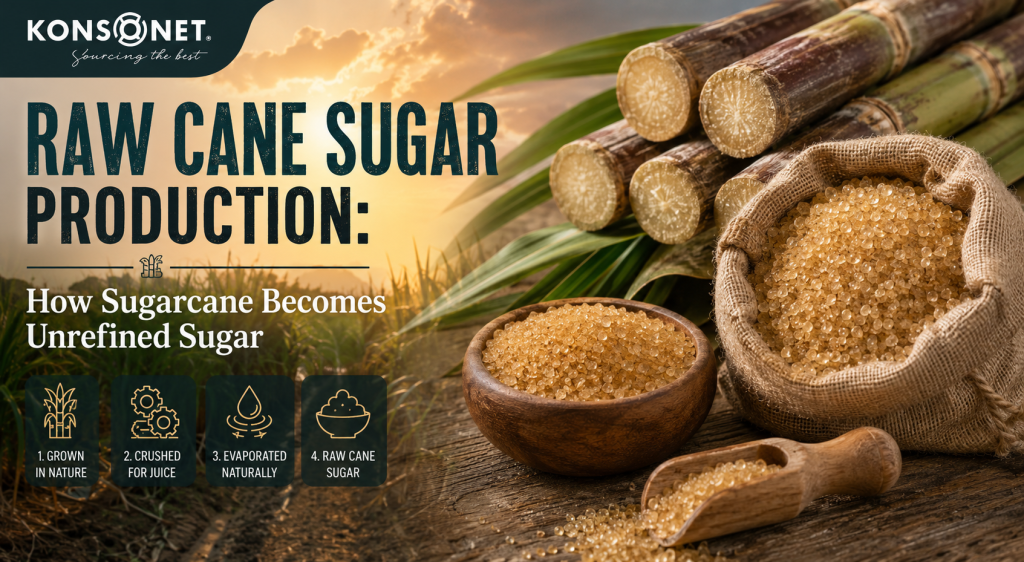
Sugar production begins long before crystals reach food manufacturers, wholesalers or retail shelves. It starts in sugarcane fields, where mature stalks are harvested and transported to processing facilities. Through a carefully managed sequence of extraction, clarification, evaporation and crystallisation, the natural sucrose contained in sugarcane juice is converted into solid sugar crystals.
Understanding how raw cane sugar is produced provides valuable insight into the agricultural and industrial processes behind this widely traded ingredient. Each manufacturing stage influences the characteristics of the final product, including its colour, crystal size, moisture content, purity and consistency.
For food manufacturers, distributors and wholesale buyers in Lithuania and across Europe, understanding these processes also helps when evaluating product specifications and sourcing requirements.
This guide explores the complete production journey, from harvesting sugarcane to drying, grading and packaging the finished sugar.
1. Understanding Raw Cane Sugar Production
Raw cane sugar is produced by extracting juice from sugarcane stalks, processing the liquid to concentrate its sucrose content and allowing sugar crystals to develop.
Sugarcane contains sucrose dissolved in water, together with naturally occurring organic compounds, minerals, plant fibres and other non-sugar substances. The purpose of sugar manufacturing is to recover sucrose while controlling the presence of these other components.
Unlike fully refined white sugar, certain unrefined cane sugar products retain some of the natural cane molasses associated with the production process. This contributes to differences in colour, aroma, flavour and physical characteristics.
However, raw cane sugar is not a single uniform product. Different manufacturing methods and processing conditions can produce sugars with varying levels of colour, moisture, crystal size and molasses content.
The final characteristics depend on the production method, the extent of clarification, crystallisation conditions and how the crystals are separated and handled.
2. Sugarcane Harvesting and Preparation
The first stage of production takes place in the sugarcane fields. The quality of the harvested cane has a direct influence on the efficiency of subsequent manufacturing operations.
Selecting Mature Sugarcane
Sugarcane is generally harvested when the stalks have reached suitable maturity and contain sufficient sucrose for commercial processing.
Several factors influence cane quality, including:
- Sugarcane variety and growing conditions.
- Soil composition and agricultural management.
- Weather patterns and rainfall.
- Crop maturity at harvesting.
- Time between harvesting and factory processing.
Harvesting too early may result in lower sucrose accumulation, while delayed harvesting can affect crop condition depending on the local climate and agricultural circumstances.
For sugar manufacturers, selecting suitable harvesting periods helps maintain a consistent supply of cane with appropriate processing characteristics.
Manual and Mechanical Harvesting
Sugarcane can be harvested manually or mechanically.
Manual harvesting involves workers cutting the mature stalks near ground level and removing unwanted leaves and tops. Mechanical harvesting uses specialised equipment to cut and collect the stalks more efficiently.
The method depends on farm size, terrain, labour availability and the equipment used in the growing region.
After cutting, the cane is transported to a sugar mill. Minimising unnecessary delays is important because harvested sugarcane can deteriorate during storage. Prolonged delays may encourage microbial activity and sucrose losses.
Cleaning and Cane Preparation
Before juice extraction, harvested cane passes through preparation equipment.
The main activities include:
- Removing soil, leaves and unwanted plant material.
- Cutting stalks into smaller sections.
- Shredding or crushing the cane to open its fibrous structure.
- Preparing the material for efficient juice extraction.
Cane knives, shredders and related equipment help break down the stalks and expose the juice-containing plant cells.
Proper preparation improves the effectiveness of the extraction stage and helps reduce the amount of sucrose remaining in the fibrous residue.
3. Sugarcane Juice Extraction
Once the cane has been prepared, the next objective is to extract the sucrose-containing juice.
Two commonly used industrial methods are mechanical milling and diffusion.
Mechanical Milling
Mechanical milling is a widely established method of extracting juice from sugarcane.
Prepared cane passes through a series of heavy-duty rollers that apply pressure to the fibrous material. This pressure releases the juice, which is collected and transferred for further processing.
Modern milling systems may use several roller sets arranged in sequence to improve extraction efficiency.
Water or diluted juice may also be introduced between milling stages. This practice, known as imbibition, helps wash additional sucrose from the remaining fibre.
The extracted liquid is collected as raw cane juice, while the fibrous residue is separated.
Diffusion Extraction
Diffusion is another industrial method used to recover sugar from prepared sugarcane.
Instead of relying primarily on repeated mechanical pressing, diffusion uses water to extract sucrose from the prepared cane material through controlled contact.
The shredded cane moves through a diffuser, where water passes through the material and dissolves the available sucrose.
The resulting juice is collected for processing, while the remaining fibrous material is removed.
Both milling and diffusion aim to recover as much available sucrose as practical while maintaining efficient factory operations.
What Happens to Bagasse?
The fibrous material remaining after juice extraction is known as bagasse.
Rather than treating it simply as waste, sugar factories can use bagasse as a valuable processing by-product.
Common applications include:
- Fuel for boilers used in sugar production.
- Generation of steam for industrial operations.
- Cogeneration of electricity.
- Production of certain fibre-based materials.
Using bagasse as a source of process energy can reduce the requirement for external fuel, depending on factory design and energy demand.
4. Juice Clarification and Impurity Removal
Freshly extracted sugarcane juice contains more than dissolved sucrose. It may also contain suspended fibres, soil particles, plant waxes, proteins, organic compounds and other impurities.
Clarification is therefore an important stage in producing consistent sugar.
Screening and Initial Filtration
The extracted juice first passes through screening or filtration equipment to remove larger suspended materials.
This may include fine cane fibres and other particles carried over from the extraction stage.
Removing these materials helps prepare the juice for subsequent clarification.
Heating and Chemical Treatment
Depending on the manufacturing process, the juice may be heated and treated with a controlled quantity of lime.
Lime treatment helps adjust the juice’s acidity and encourages certain impurities to form larger particles or precipitates.
These particles can then be separated from the liquid through settling and clarification.
The exact clarification method varies between factories. Different facilities may use different combinations of heating, pH adjustment, settling, filtration and other approved processing techniques.
It is important to distinguish clarification from refining. Clarification prepares the extracted juice for concentration and crystallisation. Full refining involves additional purification stages designed to produce a more highly purified sugar.
Separation of Clarified Juice
After treatment, the juice enters clarification equipment, where heavier suspended material settles and the clearer liquid is separated.
The removed solids are commonly referred to as press mud or filter cake after filtration.
Depending on local practices and applicable regulations, this material may be used in agricultural applications, including soil improvement.
The clarified juice continues to the evaporation stage.
5. Evaporation: Concentrating the Sugarcane Juice
After clarification, the juice still contains a substantial quantity of water. Its sucrose concentration must increase before crystals can form efficiently.
Evaporation removes excess water and converts the relatively dilute juice into concentrated syrup.
How Industrial Evaporation Works
Sugar factories commonly use multiple-effect evaporators.
These systems pass juice through a sequence of vessels operating under different pressure conditions. Steam and vapour are used efficiently to remove water while limiting unnecessary energy consumption.
As water evaporates, the dissolved sugar becomes progressively more concentrated.
The objective is to produce a thick syrup with a suitable concentration for controlled crystallisation.
Why Temperature Control Matters
Temperature and pressure management are important during evaporation.
Excessive heat exposure can encourage sucrose degradation and unwanted colour formation. Poorly controlled conditions may also affect the efficiency of subsequent crystallisation.
Vacuum operation allows evaporation at lower temperatures than would otherwise be required under atmospheric pressure.
The concentrated syrup is then transferred to the crystallisation section.
6. Sugar Crystallisation: Forming Raw Cane Sugar Crystals
Crystallisation is one of the most important stages in the entire manufacturing process.
At this point, the concentrated syrup contains dissolved sucrose at a level where controlled crystal formation becomes possible.
Understanding Supersaturation
A sugar solution becomes supersaturated when it contains more dissolved sucrose than it can normally maintain under the existing temperature and concentration conditions.
This creates the conditions required for sucrose molecules to separate from the liquid and form solid crystals.
Manufacturers carefully control concentration, temperature and evaporation to achieve suitable supersaturation.
Crystal Seeding
Crystal seeding is used to encourage controlled crystal formation.
Small sugar crystals or prepared seed material are introduced into the concentrated syrup. Dissolved sucrose then deposits onto these seeds, allowing the crystals to grow.
Controlling the number of seed crystals and their growth conditions helps manufacturers achieve more consistent crystal sizes.
Vacuum Pan Crystallisation
Industrial sugar production commonly uses vacuum pans for crystallisation.
These vessels allow the syrup to be concentrated under reduced pressure. Water continues to evaporate, while the remaining sucrose forms crystals.
The resulting mixture contains solid sugar crystals suspended in concentrated mother liquor.
This mixture is known as massecuite.
The consistency of the massecuite and the size of its crystals influence the efficiency of the next separation stage.
7. Separating Sugar Crystals from Molasses
Once crystallisation has produced massecuite, the sugar crystals must be separated from the surrounding liquid.
This operation is generally performed using centrifugal machines.
How Centrifugation Works
A centrifuge contains a rotating basket with a perforated lining.
When massecuite enters the machine, centrifugal force pushes the liquid component through the basket lining while the solid sugar crystals remain inside.
The liquid separated during this operation is known as mother liquor or molasses, depending on its composition and position within the production process.
The separated sugar crystals may undergo controlled washing, depending on the product specification and manufacturing method.
Washing can remove some of the syrup adhering to the crystal surfaces. However, the extent of washing influences the amount of molasses retained on the crystals.
Why Molasses Separation Matters
The relationship between crystal separation and retained molasses influences several characteristics of unrefined sugar.
These include:
- Colour intensity.
- Moisture content.
- Aroma and flavour.
- Crystal surface characteristics.
- Storage and handling behaviour.
The objective is not necessarily to remove every trace of molasses. Different unrefined sugar products require different processing outcomes.
For example, some dry granulated products require free-flowing crystals with controlled moisture, while softer sugar products retain more molasses and moisture.
What Happens to the Separated Molasses?
Molasses is a valuable co-product of sugar manufacturing.
Depending on its composition and local industrial facilities, it can be used in fermentation, alcohol production, animal feed applications and other industrial processes.
Its composition changes during successive sugar recovery stages because the remaining liquid contains different proportions of sucrose and non-sugar components.
8. Drying, Cooling and Grading
After centrifugation, the separated sugar crystals may still contain moisture.
Drying and cooling help prepare the crystals for storage, handling and packaging.
Drying the Sugar Crystals
Industrial sugar dryers use controlled airflow and temperature to reduce moisture.
The drying conditions must be appropriate for the sugar type. Excessive heat or unsuitable handling may affect crystal quality, while insufficient drying can increase the risk of clumping during storage.
The aim is to achieve the moisture level specified for the intended product.
Cooling Before Storage
After drying, sugar is generally cooled before entering storage or packaging systems.
This helps prevent condensation and moisture-related problems when the product moves into a different temperature environment.
Maintaining suitable environmental conditions is particularly important for products intended for extended storage or international distribution.
Grading by Crystal Size
Sugar crystals are passed through screening equipment to separate different particle sizes.
Vibrating screens or similar grading systems can classify crystals into specified size ranges.
Particle size matters because it affects handling, dissolution behaviour, product appearance and suitability for particular manufacturing applications.
For example, coarse crystals and fine granulated sugar may require different specifications depending on the intended end use.
9. Packaging and Storage of Unrefined Sugar
Once processing and grading are complete, the sugar is prepared for commercial storage and distribution.
Packaging must protect the product from moisture, contamination and physical damage.
Selecting Suitable Packaging
Different packaging formats are used depending on the target market and customer requirements.
Common options include:
- Retail packs for consumer distribution.
- 25 kg bags for commercial food production.
- 50 kg bags for wholesale supply.
- Large bags or bulk formats for industrial customers.
Food-grade packaging materials should provide suitable protection against external moisture and contamination.
Storage Conditions
Unrefined cane sugar should be stored in clean, dry and appropriately ventilated conditions.
Important considerations include:
- Maintaining controlled storage humidity.
- Preventing contact with water.
- Protecting products from pests.
- Avoiding contamination from other stored materials.
- Keeping packaging sealed and undamaged.
- Following the supplier’s recommended storage conditions.
Poor storage management can lead to clumping, changes in texture and deterioration of product handling characteristics.
10. Factors Affecting Final Raw Cane Sugar Quality
The final quality of raw cane sugar depends on several connected agricultural and manufacturing factors.
Understanding these factors is useful for both sugar producers and wholesale buyers.
Sugarcane Quality
The sucrose content and condition of harvested cane influence the quantity and quality of juice available for processing.
Immature cane, damaged stalks and delays between harvesting and crushing may affect production efficiency.
Extraction Efficiency
The performance of milling or diffusion equipment determines how effectively sucrose is recovered from the cane.
Poorly maintained equipment or inadequate preparation may leave more sugar in the fibrous residue.
Clarification Performance
Effective clarification helps control suspended solids and other impurities entering the evaporation system.
Inconsistent treatment can influence juice quality and downstream processing performance.
Crystallisation Conditions
Temperature, concentration, supersaturation and seeding influence crystal growth.
Poor control can result in inconsistent crystal size and reduced separation efficiency.
Molasses Retention
The amount of molasses remaining on or around the crystals influences colour, flavour, moisture and texture.
This is particularly relevant when manufacturing different grades of unrefined cane sugar.
Moisture and Storage Management
Moisture control is essential for maintaining product stability and free-flowing characteristics.
Even sugar that meets its initial production specification can develop handling problems if it is exposed to unsuitable storage conditions.
11. Commercial Applications and Wholesale Considerations
Raw cane sugar is supplied to different sectors of the food and beverage industry. Its suitability depends on product specifications, processing characteristics and customer requirements.
Food manufacturers may require particular crystal sizes, colour ranges, moisture levels and consistency between deliveries.
For wholesale buyers in Lithuania and other European markets, evaluating a supplier involves more than comparing product descriptions.
Understanding Product Specifications
A technical specification sheet provides important information about the product being purchased.
Buyers should review:
- Product name and description.
- Country of origin and manufacture.
- Polarisation or sucrose purity.
- Moisture content.
- Colour measurement.
- Crystal size distribution.
- Food safety requirements.
- Packaging format.
- Storage recommendations.
These parameters help manufacturers determine whether a particular sugar meets their production requirements.
Importance of Batch Consistency
Consistency between batches is important for commercial food production.
Changes in moisture, colour or crystal size can influence ingredient handling and the characteristics of finished products.
Buyers should therefore request current specifications and, where appropriate, batch-specific quality documentation.
Food Safety and Traceability
Commercial buyers should also consider the supplier’s food safety procedures and traceability arrangements.
Relevant documentation may include:
- Product technical specifications.
- Certificates of analysis.
- Applicable food safety certifications.
- Batch identification and traceability information.
- Origin and manufacturing details.
- Packaging and storage information.
Requirements should be checked against the relevant regulations and the buyer’s intended application.
Wholesale Packaging and Logistics
Packaging and transport arrangements can influence the condition of sugar when it reaches the customer.
Buyers should consider bag sizes, pallet arrangements, container loading, delivery terms and available stock.
For businesses sourcing sugar in Lithuania, working with an established importer and distributor can help simplify product selection and supply coordination.
Konsonetas is a Lithuania-based company specialising in the import, export, packing and distribution of unrefined sugar from Mauritius, alongside cocoa products. Its wholesale range includes different cane sugar products and packaging formats for commercial customers.
Businesses can explore the available bulk-packed food products to review product availability and commercial supply information.
12. How Different Processing Specifications Influence Sugar Products
Although the fundamental production stages are similar, variations in processing and finishing can produce different types of unrefined cane sugar.
For example, dry granulated sugars generally require controlled moisture and consistent crystal grading. Softer products retain more molasses and have different moisture and texture characteristics.
These differences are determined by processing conditions rather than simply by the name given to the finished product.
Wholesale buyers can compare the characteristics of individual products through technical specifications.
For example, the Mauritius cane sugar range provides information about different sugar grades, while the Fine Demerara product specifications illustrate how crystal size, moisture and colour can be described through measurable parameters.
Similarly, the Molasses Sugar product information demonstrates how products with different retained molasses characteristics have distinct physical specifications.
These comparisons help commercial buyers understand why reviewing technical documentation is important before selecting an ingredient for a particular manufacturing application.
Conclusion
The production of raw cane sugar involves a series of interconnected agricultural and industrial operations. From harvesting and preparing sugarcane to extracting juice, clarifying the liquid, concentrating syrup and forming sucrose crystals, each stage contributes to the characteristics of the final product.
The separation of crystals from molasses, followed by drying, grading and packaging, prepares the sugar for commercial distribution.
For manufacturers and wholesale buyers, understanding this process provides a useful foundation for evaluating product quality, technical specifications and supplier consistency.
Whether sourcing sugar for food manufacturing, wholesale distribution or other commercial applications, paying attention to processing characteristics and product documentation can support better purchasing decisions.
To explore unrefined cane sugar products and wholesale supply options in Lithuania, contact Konsonetas to discuss your business requirements.
Frequently Asked Questions (FAQs)
1. How is raw cane sugar produced?
Raw cane sugar is produced by extracting juice from harvested sugarcane, clarifying it, concentrating it through evaporation and allowing sucrose crystals to form. The crystals are then separated from molasses using centrifugation before drying, grading and packaging.
2. What is the first stage of raw cane sugar production?
The first stage is harvesting mature sugarcane. The harvested stalks are transported to a processing facility, where they are cleaned, cut and shredded to prepare them for juice extraction.
3. How is sugarcane juice extracted?
Sugarcane juice is commonly extracted through mechanical milling or diffusion. Milling uses heavy rollers to press juice from prepared stalks, while diffusion uses water to recover dissolved sucrose from the prepared cane material.
4. Why is clarification important in sugar production?
Clarification removes suspended fibres, plant particles and other impurities from extracted sugarcane juice. This helps prepare the liquid for evaporation and supports more consistent downstream processing.
5. How are sugar crystals separated from molasses?
The crystallised sugar mixture, known as massecuite, is transferred to centrifugal machines. Centrifugal force separates the solid sugar crystals from the surrounding liquid, which becomes the molasses stream.
6. What factors affect the quality of raw cane sugar?
Important factors include sugarcane maturity, harvesting conditions, extraction efficiency, clarification performance, crystallisation control, molasses retention, moisture levels and storage conditions. These influence colour, purity, crystal size, texture and consistency.
7. What is the difference between raw cane sugar and refined sugar?
Raw cane sugar generally undergoes juice extraction, clarification, concentration and crystallisation, with some cane molasses retained depending on the product. Refined sugar undergoes additional purification and decolourisation stages to produce a more highly purified sugar with a lighter appearance.
8. What should wholesale buyers check when sourcing raw cane sugar?
Wholesale buyers should review product specifications, sucrose purity, moisture content, colour, crystal size, country of origin, food safety documentation, packaging formats and storage recommendations. Batch consistency and reliable supply arrangements are also important considerations.