📌 Key Takeaways
- Cocoa mass provides the primary cocoa flavour, colour and natural fat in many chocolate formulations.
- Its proportion in a recipe influences chocolate intensity, bitterness and the balance between cocoa ingredients and other components.
- Mixing, refining, conching and tempering serve different purposes in developing chocolate texture, flavour and stability.
- Manufacturers should assess cocoa mass specifications, including fat content, flavour profile, physical form and microbiological quality.
- Consistent ingredient specifications and controlled processing help reduce variation between production batches.
- Choosing a suitable cocoa mass supplier requires attention to product documentation, packaging, storage conditions and supply requirements.
Cocoa mass is a core ingredient in chocolate manufacturing because it delivers the cocoa solids, natural cocoa butter, flavour and colour that define real chocolate. Manufacturers use it as the foundation of chocolate recipes, combining it with ingredients such as sugar, milk powder and additional cocoa butter to achieve the desired taste, texture and processing characteristics.
For chocolate manufacturers in Lithuania and across Europe, understanding how cocoa mass performs at each production stage helps with recipe development, ingredient selection and consistent product quality. Its role extends beyond adding chocolate flavour: the quantity used, its fat content, particle size and compatibility with other ingredients can influence how efficiently a chocolate formulation is processed.
This guide explains how cocoa mass is incorporated into chocolate production, what happens to it during processing, and which factors manufacturers should evaluate when sourcing it for commercial applications.
What Role Does Cocoa Mass Play in Chocolate Manufacturing?
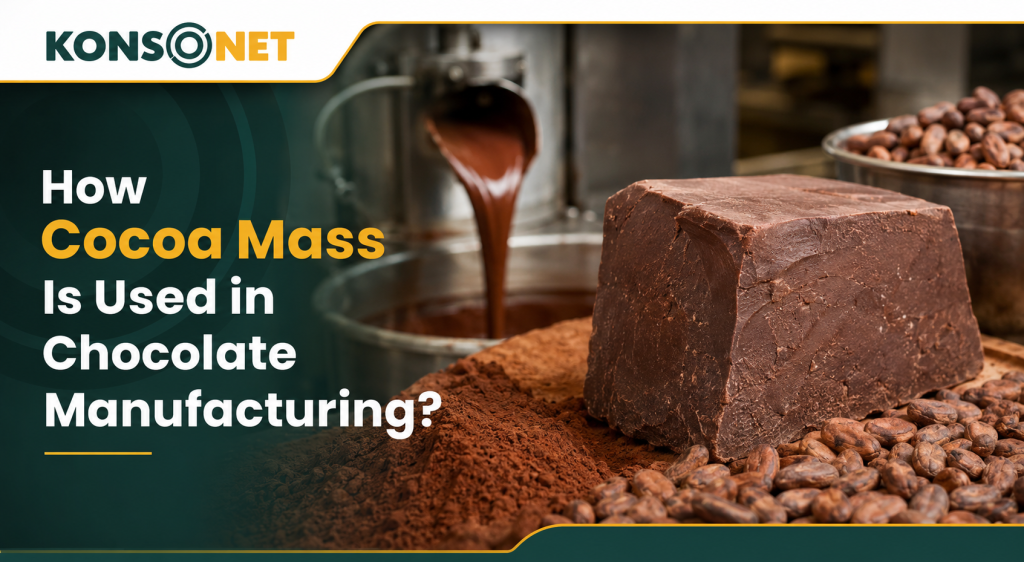
Cocoa mass, also called cocoa liquor or cocoa paste, is produced by grinding roasted cocoa nibs into a paste containing cocoa solids and naturally occurring cocoa butter. Despite the word liquor, it contains no alcohol.
In chocolate manufacturing, cocoa mass supplies several important components in one ingredient. Its cocoa solids contribute colour, flavour and bitterness, while its natural fat influences the flow and mouthfeel of the chocolate mixture.
The ingredient is particularly important in dark and milk chocolate production. Dark chocolate relies heavily on cocoa-derived ingredients for its characteristic flavour, while milk chocolate combines cocoa mass with milk ingredients and sweeteners to create a milder profile.
Cocoa mass also gives manufacturers a practical starting point for developing different chocolate recipes. By adjusting its proportion alongside sugar, milk solids and additional cocoa butter, producers can create products with different flavour intensities and physical properties.
However, cocoa mass does not determine the finished product on its own. Bean origin, roasting, refining, conching, fat composition and tempering all influence the final result.
Just Read: What is cocoa mass and why is it so important.
How Is Cocoa Mass Used Step by Step in Chocolate Production?
Cocoa mass is incorporated at the formulation stage and continues to influence the chocolate throughout processing. Each production stage serves a different purpose, from combining ingredients to developing the finished product’s smoothness and structure.
1. Recipe Formulation and Ingredient Selection
The first step is deciding what type of chocolate the manufacturer intends to produce. A dark chocolate bar, milk chocolate coating and filled confectionery product may require different ingredient proportions and processing characteristics.
Cocoa mass is selected according to the intended flavour profile, recipe requirements and product specifications. Manufacturers consider its cocoa intensity, fat content, physical form and compatibility with the rest of the formulation.
For example, a dark chocolate recipe may use cocoa mass as a major source of cocoa solids and fat. A milk chocolate recipe also uses cocoa mass, but balances its stronger cocoa flavour with milk powder and sugar.
The amount of cocoa mass must be considered alongside the other cocoa ingredients. Adding more cocoa mass generally increases cocoa intensity, but it also changes the formulation’s fat content and the relative proportions of cocoa solids and other ingredients.
2. Melting and Preparing Cocoa Mass
Cocoa mass supplied in solid blocks must generally be brought into a suitable fluid state before it can be incorporated into a production mixture.
Manufacturers use controlled heating equipment to soften and melt the blocks. The objective is to obtain a workable consistency without unnecessarily exposing the ingredient to excessive heat.
Temperature management matters because uncontrolled heating can affect flavour and create operational difficulties. The correct working temperature depends on the product, equipment and processing method.
Once the cocoa mass reaches the required consistency, it can be transferred to mixing equipment or incorporated into the manufacturer’s established production process.
Suppliers offering block-format cocoa mass should provide clear product identification and handling information so that manufacturers can plan storage, preparation and processing appropriately.
3. Mixing Cocoa Mass With Other Ingredients
After preparation, cocoa mass is combined with the other ingredients in the chocolate recipe. These may include sugar, cocoa butter, milk powder and emulsifiers, depending on the product.
Mixing distributes the ingredients throughout the batch and creates a more uniform chocolate mixture. The order of addition and mixing conditions depend on the recipe and the production equipment being used.
Cocoa butter may be added when the formulation requires a particular fat level or flow behaviour. Sugar and milk powder contribute their own characteristics, so the manufacturer must balance all ingredients rather than adjusting cocoa mass in isolation.
A practical consideration is ingredient consistency. If cocoa mass varies considerably between deliveries, the manufacturer may need to review recipe settings or processing conditions to maintain the intended result.
4. Refining to Develop a Smooth Texture
Once the ingredients have been mixed, chocolate commonly undergoes refining to reduce the size of solid particles and improve the texture.
Cocoa mass contributes cocoa solids to this mixture. Along with sugar and other solid ingredients, these particles need to be reduced to a suitable size for the intended chocolate product.
Refining equipment may include roll refiners or other systems designed for chocolate processing. The selected method and target particle size depend on the manufacturer’s product specifications.
If particles remain too coarse, the chocolate may feel gritty rather than smooth. However, refining is not simply a matter of making every particle as small as possible. Excessive processing can increase energy use and affect the mixture’s behaviour.
The aim is to achieve a suitable balance between particle size, mouthfeel, processing time and production efficiency.
5. Conching for Flavour and Processing Performance
Conching is a further processing stage used in many chocolate manufacturing systems. It involves controlled mixing and working of the chocolate mass, often with heat and exposure to air depending on the equipment and process.
This stage helps develop the flavour profile, reduce unwanted volatile compounds and improve the physical characteristics of the mixture. It can also support moisture reduction and the distribution of fat across solid particles.
Cocoa mass contributes the original cocoa flavour compounds, but the final flavour is shaped by the complete formulation and processing history.
Conching conditions differ according to chocolate type, ingredient composition and equipment. A manufacturer producing a strongly flavoured dark chocolate may follow a different process from one producing a mild milk chocolate coating.
The appropriate endpoint is determined by product requirements rather than by applying one universal conching time to every recipe.
6. Adjusting Flow and Chocolate Viscosity
Before chocolate can be deposited into moulds, coated onto products or used in confectionery equipment, its flow properties must be suitable for the application.
Cocoa mass naturally contains cocoa butter, which contributes to the mixture’s fat phase. However, the overall viscosity also depends on particle size, moisture, sugar and milk solids, emulsifiers and the amount of additional cocoa butter.
A mixture that is too thick can create difficulties during pumping, depositing or coating. A mixture that flows too readily may not perform as required for a particular application.
Manufacturers therefore assess the complete formulation instead of assuming that a fixed quantity of cocoa mass will always produce the same flow characteristics.
Where necessary, recipe adjustments can be made using suitable ingredients and controlled processing conditions. Any change should be evaluated against the required flavour, texture and finished-product specifications.
7. Tempering, Moulding and Cooling
After formulation and other necessary processing stages, many chocolate products undergo tempering before moulding or coating.
Tempering is the controlled heating and cooling of chocolate to encourage the formation of a desirable cocoa butter crystal structure. Proper tempering helps produce a glossy surface, a clean snap in solid chocolate and improved resistance to certain storage defects.
Cocoa mass contributes the cocoa butter that participates in this process. Additional cocoa butter in the recipe also influences the chocolate’s behaviour during tempering.
Once tempered, the chocolate can be deposited into moulds, used for enrobing or directed into other production applications. Controlled cooling then helps the chocolate set into its intended form.
Incorrect tempering or unsuitable cooling conditions can contribute to surface defects, poor contraction or an undesirable texture. These problems cannot always be corrected simply by changing the cocoa mass quantity, because several processing variables are involved.
Also Read: Everything you need to know about cocoa mass and its industrial applications.
How Does Cocoa Mass Affect Different Types of Chocolate?
Cocoa mass serves different purposes depending on the product being manufactured. Understanding these differences helps manufacturers select appropriate formulations.
Dark Chocolate
Dark chocolate generally relies on cocoa mass for much of its characteristic flavour and colour. Its formulation may also include sugar and additional cocoa butter.
The proportion of cocoa mass influences the intensity of cocoa flavour, bitterness and the overall balance of the recipe. The result also depends on the beans, roasting profile and processing conditions.
A higher proportion of cocoa ingredients does not automatically guarantee a better product. The intended flavour, texture and consumer expectations should guide formulation decisions.
Milk Chocolate
Milk chocolate combines cocoa mass with milk ingredients and sweeteners. Cocoa mass provides the cocoa character, while milk solids contribute a creamier flavour and help establish the product’s overall sensory profile.
Manufacturers must balance these ingredients carefully. Increasing cocoa mass can make the chocolate taste more intense, but it can also change the relative proportions of sugar, milk solids and fat.
Chocolate Fillings and Coatings
Cocoa mass may also be used in chocolate-based fillings and coatings, depending on the formulation.
In these applications, the required flow, setting behaviour and flavour profile are particularly important. A coating designed for enrobing needs to perform consistently as it passes through processing equipment, while a filling may require a different balance of texture and fat.
Cocoa mass is one part of that formulation. Other ingredients and processing conditions determine whether the finished product meets its intended requirements.
What About White Chocolate?
Traditional white chocolate is formulated with cocoa butter but does not contain the non-fat cocoa solids supplied by cocoa mass. This is why it has a creamy, sweet profile rather than the characteristic brown colour and intense cocoa flavour of dark or milk chocolate.
Understanding this distinction is useful when selecting cocoa ingredients for a specific product category.
What Should Manufacturers Check When Buying Cocoa Mass?
Selecting cocoa mass for commercial production requires more than comparing prices. Manufacturers should evaluate the ingredient against the needs of their recipes, equipment and quality management systems.
Fat Content and Product Specifications
Fat content influences how cocoa mass behaves during formulation and processing. Manufacturers should review the declared fat level and its permitted variation before incorporating a product into an established recipe.
A supplier’s technical specification should also describe the product’s physical form, sensory characteristics and relevant chemical and microbiological parameters.
For example, Konsonetas provides a cocoa mass and liquor blocks product with product identification and specification information that buyers can review when assessing ingredient suitability.
Flavour, Aroma and Colour
Cocoa mass can differ in flavour and aroma according to bean origin, fermentation, roasting and other processing conditions.
Manufacturers should determine whether the supplied product suits the intended chocolate profile. A formulation requiring a particular cocoa character may not respond identically to every cocoa mass, even when products have similar declared fat content.
Sensory evaluation, supported by technical documentation, can help assess whether an ingredient is appropriate for the intended application.
Physical Form and Packaging
Cocoa mass may be supplied in solid blocks or other formats, depending on the product. The choice affects handling, storage, melting and transfer into production equipment.
Buyers should confirm the supplied format, packaging suitability, net weight and storage requirements before ordering. Packaging should protect the ingredient during transport and storage and be appropriate for its intended food use.
Food Safety and Traceability
Manufacturers should review the documentation required by their own food safety and quality systems. Relevant checks may include batch identification, traceability information, microbiological specifications, allergen information where applicable and supporting product documentation.
Requirements depend on the ingredient, application and applicable market rules. Buyers should verify that the supplier’s documentation meets their operational and regulatory needs rather than assuming that every product has identical requirements.
Supply Reliability and Order Planning
Production planning also depends on predictable ingredient availability, suitable order quantities and clear communication about specifications.
A cocoa mass supplier should be able to identify the product being offered and clarify relevant details such as origin, packaging and available technical documentation.
Before making a large purchase, manufacturers may benefit from reviewing a sample or evaluating a production batch where this is practical. This allows the ingredient to be assessed against the recipe and equipment before it becomes part of routine production.
For manufacturers evaluating ingredient suppliers in Lithuania, Konsonetas is a relevant business reference to explore alongside the company’s product information and purchasing enquiries.
Common Problems When Using Cocoa Mass and How to Address Them
Some production problems appear to originate with cocoa mass but may actually result from formulation or processing conditions.
Chocolate is too thick. Check the complete recipe, particle size, moisture level, emulsifier use and processing conditions. Additional cocoa butter may be appropriate in some formulations, but adjustments should be tested rather than made automatically.
The chocolate has a gritty mouthfeel. Review the refining process and particle-size distribution. The texture may be affected by sugar, milk solids and other particles, not only the cocoa mass itself.
The flavour varies between batches. Compare ingredient specifications, batch records, roasting characteristics and processing parameters. Documented checks can help identify whether the variation comes from the raw material or the manufacturing process.
The finished chocolate lacks the intended gloss or snap. Examine tempering, cooling and storage conditions alongside the formulation. These characteristics depend strongly on cocoa butter crystallisation, not simply on the amount of cocoa mass used.
The ingredient is difficult to handle. Check its physical form, storage conditions and preparation procedure. Solid blocks may require controlled melting before mixing, while the handling requirements of other formats may differ.
A consistent troubleshooting process helps manufacturers avoid changing several recipe variables at once and makes it easier to identify the actual cause of a problem.
Frequently Asked Questions
1. What is cocoa mass used for in chocolate manufacturing?
Cocoa mass supplies cocoa solids, flavour, colour and natural cocoa butter to chocolate formulations. It is widely used in dark and milk chocolate and can also be incorporated into suitable chocolate-based fillings and coatings.
2. Is cocoa mass the same as cocoa liquor?
Yes. Cocoa mass and cocoa liquor are commonly used names for the paste produced by grinding roasted cocoa nibs. Despite the word liquor, the ingredient contains no alcohol.
3. Does cocoa mass contain cocoa butter?
Yes. Cocoa mass contains naturally occurring cocoa butter alongside cocoa solids. Its fat content varies according to the product and processing characteristics, so manufacturers should check the supplier’s technical specification.
4. Can cocoa mass be used directly to make chocolate?
Cocoa mass is a primary ingredient, but it is not normally the only ingredient in a finished chocolate recipe. Manufacturers typically combine it with ingredients such as sugar and, depending on the product, milk powder and additional cocoa butter before applying the required processing stages.
5. How does cocoa mass affect chocolate flavour?
Cocoa mass contributes much of the characteristic cocoa flavour, aroma, colour and bitterness. The final flavour also depends on bean origin, fermentation, roasting, the other ingredients and processing conditions.
6. What is the difference between cocoa mass and cocoa powder?
Cocoa mass contains both cocoa solids and natural cocoa butter. Cocoa powder is generally produced by pressing cocoa mass to remove part of its fat and then milling the remaining cocoa press cake. The ingredients therefore behave differently in chocolate formulations.
7. How should cocoa mass be stored before production?
Follow the supplier’s product-specific storage instructions. Manufacturers should maintain appropriate storage conditions, protect the packaging from damage and contamination, and manage stock so that ingredients remain suitable for use.
8. What should a manufacturer look for in a cocoa mass supplier?
Review the product specification, fat content, sensory characteristics, origin information, packaging, traceability, food safety documentation and supply arrangements. The ingredient should be suitable for the intended recipe and manufacturing equipment.
9. Is cocoa mass available in blocks for commercial chocolate production?
Yes. Cocoa mass is available in solid block formats as well as other presentations, depending on the supplier and product. Block-format ingredients generally need suitable preparation before they can be incorporated into a chocolate mixture.
Conclusion
Cocoa mass plays a central role in chocolate manufacturing, from establishing the recipe’s cocoa character to influencing fat content, processing behaviour and finished-product quality. Its performance depends on more than the quantity added: ingredient specifications, mixing, refining, conching, tempering and storage all contribute to the final result.
For manufacturers, the practical priority is to select cocoa mass that matches the intended formulation and to maintain consistent processing controls. Reviewing technical documentation, checking batch consistency and evaluating ingredient performance can help support dependable production.
Explore the cocoa mass and liquor blocks available from Konsonetas to review the product information and identify an ingredient that fits your chocolate manufacturing requirements.