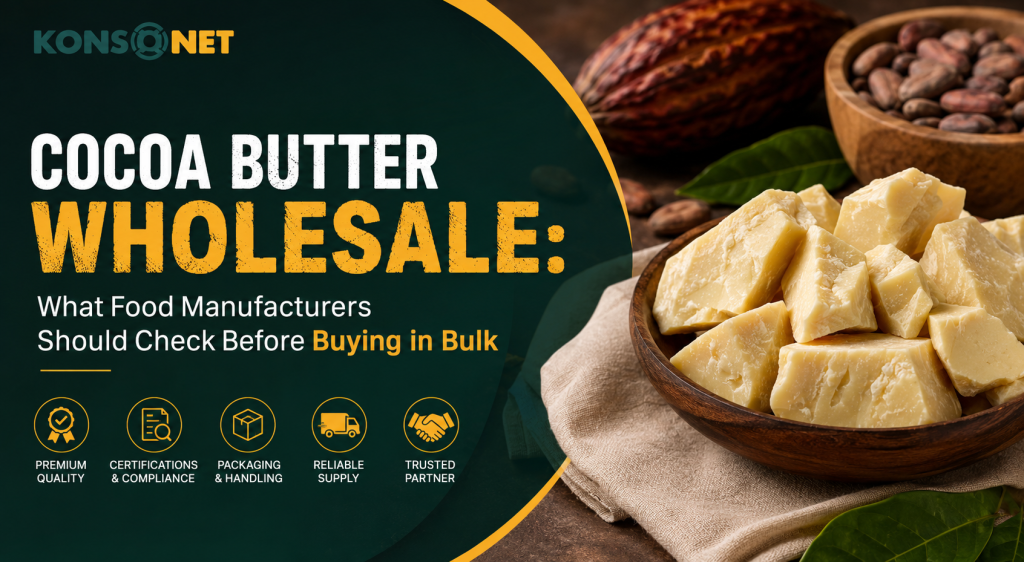
📌 Key Takeaways
- Choose the correct type: Natural cocoa butter retains more characteristic cocoa aroma, while deodorized cocoa butter has a reduced cocoa smell and is suitable for formulations requiring a more neutral flavour profile.
- Check the specifications: Review sensory characteristics, purity requirements, relevant analytical parameters, and batch-specific quality documentation before ordering.
- Calculate the complete cost: Include transport, handling, storage, minimum order quantities, and potential wastage instead of comparing product prices alone.
- Plan bulk handling: Confirm packaging sizes, pallet configuration, delivery lead times, and storage conditions before scheduling production.
- Test before scaling: Validate the cocoa butter in your own formulation and manufacturing process before committing to a large-volume purchase.
Buying cocoa butter in bulk is not simply a matter of comparing prices per kilogram. Food manufacturers need to evaluate product specifications, aroma, application suitability, batch consistency, traceability, packaging, storage requirements, and delivery reliability before committing to a wholesale order.
For businesses sourcing cocoa butter in Lithuania or elsewhere in Europe, the right purchasing decision starts with a clear specification and a supplier that can provide the documentation needed for quality control. Natural cocoa butter and deodorized cocoa butter can serve different formulation requirements, so selecting the appropriate type is essential.
This guide explains how to assess wholesale cocoa butter, compare supplier quotations, and reduce avoidable problems before placing a large order.
Why Does Wholesale Cocoa Butter Require Careful Supplier Selection?
Wholesale cocoa butter is cocoa-derived fat purchased in commercial quantities for manufacturing rather than small-scale household use. It is commonly used in chocolate, confectionery, fillings, coatings, and other food formulations where fat composition, melting behaviour, texture, and sensory properties influence the finished product.
A small difference in aroma or processing characteristics may be noticeable in one recipe but insignificant in another. Similarly, a product that performs well during initial trials may create difficulties if subsequent batches differ from the approved specification.
These considerations become more important as purchasing volumes increase. An unsuitable batch can affect several production runs, while inconsistent delivery schedules can disrupt manufacturing plans.
Before requesting quotations, establish three things: the product’s intended application, the quality parameters your production process requires, and the volume you can realistically use within your planned storage and production schedule.
This information creates a practical basis for comparing suppliers and assessing whether a proposed product is appropriate for your business.
Natural Cocoa Butter or Deodorized Cocoa Butter: Which Should You Buy?
The main distinction concerns aroma and flavour. Natural cocoa butter generally retains more of cocoa’s characteristic aroma, whereas deodorized cocoa butter undergoes additional processing to reduce that aroma.
Neither option is automatically the right choice for every food manufacturer. The decision depends on the finished product and the degree to which cocoa aroma should contribute to its overall flavour profile.
When is natural cocoa butter suitable?
Natural cocoa butter can be appropriate when a formulation benefits from the characteristic aroma associated with cocoa. Its sensory properties can contribute to the overall ingredient profile, although the intensity may vary with origin, processing, and individual specifications.
Before purchasing, ask the supplier for a product description and sensory information. If aroma is important to the finished product, assess a sample under your normal manufacturing conditions rather than relying on a description alone.
Natural cocoa butter may be worth considering for applications where the cocoa character is part of the intended sensory experience.
When is deodorized cocoa butter a better option?
Deodorized cocoa butter is processed to reduce its characteristic cocoa smell. This can help manufacturers manage flavour interactions when other ingredients are intended to provide most of the finished product’s aroma.
It may be suitable for selected chocolate formulations, confectionery products, and other food applications where a reduced cocoa aroma is preferred. However, the final choice should depend on the recipe, processing conditions, and required product characteristics.
Deodorization does not remove the need to assess purity, consistency, and food safety documentation. These remain essential purchasing considerations.
What should you confirm before ordering?
Ask the supplier to specify whether the material is natural or deodorized and whether it meets your intended application requirements. Confirm that the sample, technical specification, commercial quotation, and delivered product all refer to the same product grade.
Konsonetas provides product information for deodorized cocoa butter, including its listed product format and bulk logistics information. Buyers should check the current details and request any additional documentation needed for their own specifications.
Which Specifications Should You Check Before Buying Cocoa Butter in Bulk?
A product specification should give your quality and procurement teams enough information to determine whether the ingredient meets the requirements for the intended production process.
Rather than accepting a description such as “premium quality” as sufficient, request measurable parameters and clearly defined acceptance criteria.
1. Product identity and purity
Confirm that the material is cocoa butter intended for the required food application. Clarify whether it contains any permitted additional ingredients or processing aids that need to be considered in your specification or labelling process.
Where your purchasing standard requires it, request relevant analytical information demonstrating product identity and purity. Do not assume that two products are equivalent simply because both are labelled cocoa butter.
2. Fat composition and analytical parameters
Cocoa butter’s composition influences its crystallisation, melting behaviour, texture, and performance during processing.
Depending on your product requirements, request information about the fatty acid profile, relevant purity parameters, free fatty acids, moisture, and insoluble impurities. Confirm which methods the supplier uses and what acceptance limits apply to the specific grade.
The relevant parameters depend on the application and the product specification. There is no need to request every possible test if it does not contribute to your quality requirements, but essential acceptance criteria should be documented before purchase.
3. Appearance, aroma, and melting behaviour
Appearance and aroma can help identify obvious differences between batches, but visual inspection alone cannot establish purity or food safety.
Assess whether the product has the expected colour, appearance, and sensory characteristics. For manufacturers producing moulded chocolate or other temperature-sensitive products, also examine its processing behaviour under controlled conditions.
Ask whether the supplier can provide relevant melting or crystallisation information when this is important to your formulation.
4. Consistency between batches
Consistency is particularly important for manufacturers that operate fixed recipes and established production lines.
Request a specification that identifies the required parameters and their acceptance limits. Where appropriate, retain an approved reference sample and compare subsequent batches against the agreed criteria.
A documented process for handling out-of-specification deliveries can also help prevent disputes from disrupting production.
What Food Safety and Quality Documents Should a Supplier Provide?
A competitive price is not enough if a buyer cannot verify what is being purchased. Before placing a wholesale order, establish which documents will accompany the product and which can be supplied on request.
Depending on the product, supplier arrangements, and applicable requirements, useful documentation may include:
- Technical specification: Describes product identity, key parameters, and required acceptance criteria.
- Certificate of analysis (COA): Provides analytical results for the stated batch or lot, according to the supplier’s testing arrangements.
- Lot identification and traceability details: Allow the delivered product to be associated with the relevant production and supply records.
- Product origin information: Clarifies the origin information available for the ingredient and what can be supported by documentation.
- Shelf-life and storage guidance: Explains the supplier’s recommended conditions and the applicable date or shelf-life information.
- Food safety and allergen information: Supports the buyer’s own hazard assessment, ingredient approval, and cross-contact evaluation.
- Additional compliance documents: May be necessary where the buyer’s specification, customer requirements, or applicable legislation requires them.
Not every document is applicable to every transaction, and a certificate should not be assumed to cover tests that were never performed. Buyers should confirm the scope of testing, the date or batch reference, and whether the reported results meet their own acceptance criteria.
What should Lithuanian food manufacturers consider?
Businesses operating in Lithuania must consider applicable European Union food safety and traceability requirements alongside their own quality management procedures.
The European Commission’s overview of food traceability explains why supply chain records matter for identifying products and responding to food safety issues.
For purchasing teams, a practical approach is to ensure that each delivery can be linked to the supplier, the relevant product and lot, and the documentation required by the business. Confirm any additional legal or customer-specific requirements with the appropriate compliance professionals.
How Can You Check Whether Cocoa Butter Suits Your Manufacturing Process?
A specification can establish whether a product meets defined requirements, but it cannot always predict how that product will behave in your particular recipe.
Conducting a controlled production trial before placing a major order helps bridge that gap.
For example, a chocolate manufacturer may need to evaluate how a proposed cocoa butter grade affects viscosity during processing, tempering behaviour, mould filling, finished-product texture, and storage stability. A bakery or confectionery producer may have different priorities, including mouthfeel, flavour interactions, or fat performance in a filling.
Use a representative sample and record the relevant observations. Keep the recipe, processing temperatures, equipment settings, and evaluation method consistent wherever possible. This makes it easier to distinguish a genuine ingredient difference from changes caused by the manufacturing process.
Set acceptance criteria before testing. These might include defined sensory characteristics, processing performance, and finished-product quality requirements. If the sample passes, document the approved product specification and communicate it to the purchasing team.
Manufacturers who also use cocoa mass should evaluate how the fat ingredient fits into the complete formulation. Konsonetas’ article on how cocoa butter and cocoa mass serve different roles in chocolate production provides additional background on the functions of these ingredients.
What Packaging and Storage Conditions Matter for Bulk Orders?
Cocoa butter is sensitive to temperature conditions, and its physical state changes as it warms or cools. Packaging and storage arrangements therefore need to suit the product, the transport route, and the receiving facility.
Verify the commercial packaging format
Before confirming an order, check the net weight per carton, the type of inner packaging, pallet configuration, and the total quantity being quoted.
Konsonetas’ current cocoa butter product page lists 25 kg carton boxes and provides loading information for different shipment arrangements. Confirm availability and the packaging details that will apply to your specific order before planning warehouse space or production handling.
Packaging should protect the product from contamination, moisture exposure, and damage during normal transport and storage. Ask whether the packaging materials are appropriate for their intended food-contact use and whether each unit carries the necessary identification details.
Plan storage before the delivery arrives
Follow the supplier’s product-specific storage instructions and the procedures established by your facility. Store the material in a clean, dry environment away from direct heat, water, pests, and strong odours.
Avoid uncontrolled temperature changes that may affect handling or produce unwanted physical changes. Keep stock identified by lot and apply a documented stock rotation system based on the supplier’s date information and your internal procedures.
Where cocoa butter needs to be melted before use, ensure the production team follows an established temperature-control process suitable for the product and recipe. The objective is consistent ingredient handling rather than simply preventing the material from becoming solid.
How Should You Calculate the Real Cost of Wholesale Cocoa Butter?
The lowest quoted price per kilogram does not necessarily provide the lowest overall purchasing cost.
Compare offers using the same product type, specification, packaging format, and order quantity. Then calculate the total cost of receiving and using the ingredient.
Your assessment should consider:
- Quoted product price and minimum order quantity.
- Freight, insurance, unloading, and handling charges.
- Import-related charges where applicable.
- Warehouse space and the cost of holding inventory.
- Potential product losses, damaged packaging, or rejected batches.
- Payment terms and the amount of working capital tied up in stock.
For example, buying several pallets may reduce the transport cost per kilogram, but it can also increase inventory holding costs if your production rate is low. A smaller, more frequent delivery schedule may therefore be preferable even when the unit price is slightly higher.
Ask suppliers to quote clearly defined quantities and delivery terms so that procurement teams can compare like with like. Also confirm whether the quotation covers the entire order or whether additional logistics charges may apply.
How Can You Evaluate a Cocoa Butter Supplier?
A suitable natural cocoa butter supplier or deodorized cocoa butter supplier should be able to explain the product offered, provide relevant documentation, communicate delivery terms, and clarify how quality concerns are handled.
Supplier assessment should include more than a website description or a single quotation.
Review the supplier’s product information, business details, response to technical questions, and ability to provide documents relevant to your purchasing requirements. Ask about order availability, lead times, packaging, and the process for reporting a specification issue.
For additional business information, buyers can review Konsonetas and then confirm product-specific requirements through its published website information and direct supplier communication.
Before approving the supplier, clarify the following points in writing:
- The exact product type and agreed specification.
- The documents supplied with each order.
- Packaging, quantity, delivery schedule, and storage guidance.
- The procedure for handling quality complaints or rejected deliveries.
- How changes to specifications or product availability will be communicated.
Clear expectations help reduce misunderstandings after the purchase order has been issued. They also make repeat purchasing easier because both parties have an agreed basis for evaluating future deliveries.
Common Mistakes to Avoid When Buying Cocoa Butter Wholesale
Even experienced procurement teams can overlook details when comparing bulk ingredient offers. Several practical checks can help prevent avoidable problems.
Choosing by price alone: A cheaper product may not meet the required sensory characteristics, documentation standards, or processing needs. Compare the full specification alongside the total delivered cost.
Assuming natural and deodorized grades are interchangeable: Their sensory profiles can differ. Confirm the selected type before approving samples or placing a repeat order.
Accepting incomplete documentation: Request missing specifications or batch information before the shipment arrives, rather than discovering gaps during production.
Ordering more than the business can use: Large orders may create storage pressure and tie up working capital. Match order quantities to demand forecasts, usable shelf life, and warehouse capacity.
Skipping production trials: A supplier sample should be validated against the actual manufacturing process when product performance is important.
Leaving delivery terms unclear: Unspecified lead times, packaging arrangements, and complaint procedures can complicate purchasing. Agree on these details in writing before confirming the order.
Conclusion
Successful cocoa butter wholesale purchasing depends on matching the correct product to the manufacturing application and verifying the details that affect quality, safety, cost, and production reliability.
Manufacturers should compare natural and deodorized grades carefully, define measurable specifications, review the available documentation, test product suitability, and plan packaging and storage before ordering in bulk. Supplier communication and transparent delivery terms are equally important for maintaining a dependable supply process.
A structured purchasing checklist makes it easier to evaluate offers, control avoidable costs, and establish clear expectations for future orders.
Frequently Asked Questions
1. What should food manufacturers check before buying cocoa butter wholesale?
Check the product type, technical specifications, sensory characteristics, relevant analytical results, traceability information, packaging, storage requirements, delivery terms, and total landed cost. Test a sample where application performance is important before approving a large order.
2. What is the difference between natural and deodorized cocoa butter?
Natural cocoa butter generally retains more of its characteristic cocoa aroma, while deodorized cocoa butter undergoes additional processing to reduce that aroma. The suitable option depends on the flavour profile and processing requirements of the finished food product.
3. Is deodorized cocoa butter suitable for food manufacturing?
Deodorized cocoa butter can be suitable for food manufacturing when the product meets the application’s requirements and applicable food safety standards. Buyers should verify the intended use, product specification, and supporting documentation before approval.
4. What documents should I request from a cocoa butter supplier?
Depending on your requirements, request a technical specification, relevant certificate of analysis, lot identification and traceability details, shelf-life information, storage guidance, and food safety or allergen documentation. Confirm that the documents are applicable to the product and batch supplied.
5. How is cocoa butter packaged for wholesale supply?
Bulk cocoa butter may be supplied in cartons or other commercial formats depending on the product and supplier. Konsonetas’ current product page lists 25 kg carton boxes for its deodorized cocoa butter. Confirm current packaging, pallet configuration, and availability before ordering.
6. How should bulk cocoa butter be stored?
Follow the supplier’s product-specific storage instructions. In general, maintain a clean, dry, odour-free storage environment, protect the material from contamination and moisture, and manage stock by lot and applicable shelf-life dates.
7. How can manufacturers compare wholesale cocoa butter prices fairly?
Compare quotations for the same grade, specification, packaging, and quantity. Include transport, handling, storage, applicable import charges, and potential losses to calculate the total cost of receiving and using the ingredient.
8. Should a manufacturer test cocoa butter before ordering in bulk?
Yes, when suitability has not already been established for the exact product and application. A representative sample can be assessed for sensory characteristics and performance under the intended manufacturing conditions before a larger purchase is approved.
Looking for Cocoa Butter for Your Manufacturing Requirements?
Choosing the right bulk ingredient starts with a clear specification, transparent supply arrangements, and an understanding of your production needs. Explore the cocoa butter product information on the Konsonetas website and contact the team to discuss the required product type, documentation, packaging format, and order quantity for your business.